Showing posts with label Exodus. Show all posts

Tuesday, February 24, 2015

Pros and cons of standardizing in board games

Standardizing - yay or nay?


To even begin the discussion about standardizing game components, we need to ask ourselves if this is an actual improvement.

Having dedicated lately more than the fair share of my time to publishing rather than designing, I realized that there is a downside of standardizing - it kills some of the creativity of designers (myself included) on the altar of delivering a marketable, user-friendly, industry standard product. The designer in me is trying to fight the other side of my board gaming personality (the publisher) screaming for more freedom and less standard components. 

I - the designer - wish to have a giant board in one of my upcoming titles depicting a detailed map of the world, something which would make the War of the Ring giant board seem average, but I - the publisher - will most likely deny this request on ground of being unreasonable, too expensive and almost impossible to manufacture.

And that's not all... I - the gamer - had the pleasure of opening 46 game boxes bought in Essen and some of them gave me great joy of discovering clever assembly mechanisms and cute little tweaks which made some games special right of the box, while some others had some of the most twisted annoying components that went straight to the "I am not emotionally equipped to deal with this" shelf.

So, perhaps there's a middle ground and an agreement can be sought by the dreamy designer, the pragmatic publisher and the exigent gamer. 

Almost two years ago when NSKN Games was even younger than today, we decided to approach board game publishing with a specific set of mind - making each game component as functional as possible and packing everything in the least possible amount of space.


Same size boxes


In a post on the NSKN Games website called "Less is more" we described this "discovery" and its core principles. We adheres to these principles fully and Exodus: Proxima Centauri (revised edition), Praetor, Progress: Evolution of Technology and Versailles - board games published by NSKN Games since then - are all built accordingly. Our two upcoming titles for the first half of 2015 - Exodus: Edge of Extinction and Mistfall - are following the trend and will have the same ergonomic design. But is this all we can do? The short answer is no, there's definitely room for improvement and this is what I want to explore together with you today.


Game components one by one - standard or not?


1. Game box - it's the first thing you and I see and 90% of the times the box is the decisive factor in our interest and later buying the game or not.


Image source: BoardGameGeek
My first few games were of various sizes and shapes, from the standard square Ticket to Ride box, to the monstrous Twilight Imperium "coffin" and the tiny Catan Card Game. Through the years I have become pickier and the box of Dungeon Fighter caused me head aches because it's just marginally larger than the standard square and yet it does not fit on my very standard IKEA shelves... so I had to let it go.


Image source: thebattlestandard.com
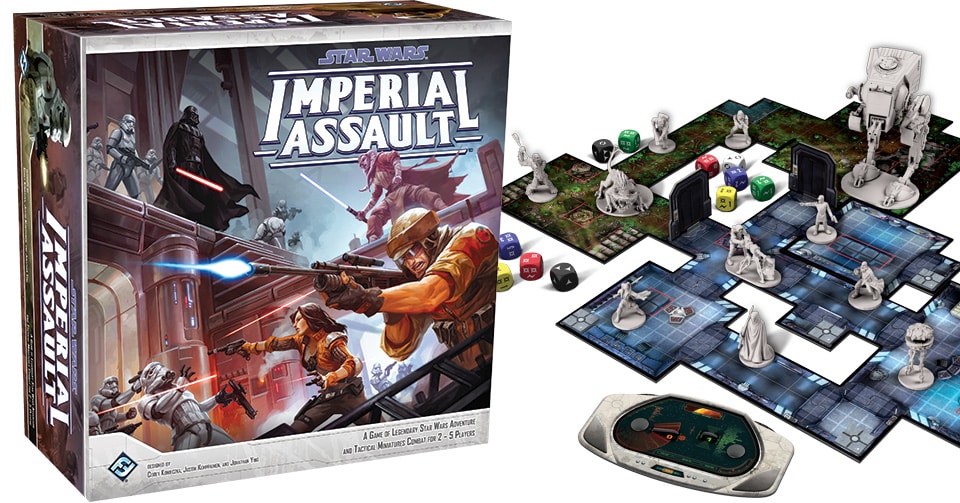
My plea if for standard boxes which save shelf space. Fantasy Flight Games - one of the trend setters in the hobby industry - has given up the iconic "coffin" boxes and switched to square boxes of various heights. I do not know the actual reason behind this move but I can speculate that they are standardizing and making their products gamer-friendly. Think only of Imperial Assault or Descent 2.0.

What is your opinion, do you prefer standard boxes or are you a fan of unlimited creativity and prefer cubical or cylindrical boxes?

2. Rules

Squares, rectangles, A5, A4, letter... the rules is modern games are all over the place. We at NSKN tried our own standard, 285x285mm booklets which are roughly the size of the box. It was or choice for the past 2 years because it allows large graphic examples, the page can be divided into 2 or 3 columns according to needs and it is cost effective.

Cost effective is one of the keys for small publishers like us to succeed. Once we evolved past the point of mere survival (as a company) we had the luxury of rethinking our publishing paradigm and look again for better solutions.

I have been advocating for "our size of the rules" for quite a while until I have recently made an experiment of my own: I took the rules of a random game, put them in both the large square format and A4 (which is almost the same as letter size) and read through them timing myself. Reading the same amount of rules text in A4 format took me about 25% less time. Therefore, the rules of our next game are coming in A4 format, even if that adds a few cents to our production costs.

Which is your preferred rules format? Do you even have one? Is this a key aspect for you when it comes to buying or even playing a game?

3. Boards

This is the point where the discussion gets complicated.

Having analyzed 50 games with non-modular boards published after 2012, I found the following distribution: more than 50% are a 4-fold square or rectangle, 30% are 6-fold rectangles and the rest are... all over the place. When it comes to modular boards, the most common shapes are rectangles, hexagons and starred hexagons, but the distribution here is too difficult to assess because of the wide range of options. Furthermore, less and less of modern board games have an actual board, with German style games sticking more to the original conservative model with an actual board.

I mentioned before that the designer in me wants a giant game board. I have spoken to a few manufacturers and the largest single piece board they can make is 100 x 70 cm and this is not really what I had in mind. Anything beyond that would require all kinds of non-standard "stuff" (I was afraid to ask) and the price would increase five to ten fold for a board just 1.5 times as large.

Comparing boards with the same total area, a 4-fold cut is 30% cheaper in average than a 6-fold cut thus the industry preference for the former. Even when it comes to ergonomics and table space, a square 4-fold cut seems preferable. And yet in Versailles we went with a larger 6-fold board very close to the manufacturer's upper limit because it suited better the game's needs. My inner fight between the designer and the publisher was a clear victory for the designer, while the publisher saw the margins decreasing under his eyes.

Using any standard game board will also save significant costs with the cutting knives when manufacturing with an established large board game factory. For small publishers saving this kind of money may very well make a big difference.

Modular boards offer a greater flexibility and sometime much greater replay value. They do not necessarily increase the manufacturing costs, but they usually do. Yet more and more designers and publishers walk this road, because creativity is no longer limited by a rectangle.

So... what is you view on game boards? With or without? Modular or classic? Does this aspect even matter when it comes to your liking and buying games? 


Conclusions?


Writing for quite a while now, I have only covered about half of the topics I had in mind. So. I'd love to see your opinions and I'll resume my train of thought next week.


__________________
FIND OUT MORE NSKN official website Facebook  | BGG
Follow us on Twitter: @NSKNGames

Friday, October 3, 2014

Versailles - A paradigm shift in game design

It's time to talk about Versailles - the latest release from NSKN Games at Spiel '14 Essen - a game which came with a significant change in the way we make games.

Many of you do not know this, but initially Versailles was called... Exodus 2: Terranova and it was created as a sequel for Exodus: Proxima Centauri.

Maybe we should first go further back into history... When we created Exodus: Proxima Centauri, we started building a quite complex universe which would cover a trilogy of games following the evolution and struggles of humanity in a dystopian future, starting with the exodus from Earth to Proxima Centauri and then following the struggle for survival against a powerful, eclectic race called the Centaurians.

While Exodus: Proxima Centauri - the first games of the series - is an empire building game, the second game was planned from the very beginning as a heavy euro, a game built around the worker placement mechanism, with several twists and a a lot of strategy to gain the scarce victory points.

Early prototype of Versailles

The first round of play testing was encouraging, it went on a little too well. You're probably thinking now "What is this guy talking about?... Is he crazy?" and in a way you're right, there should be no such thing as too good first impression when it comes to testing a board game. Let me explain...

Every game I made or contributed to had to have something special, unique, be it the theme or some mechanic. Agnieszka and I were... are very fond of the Exodus universe and I must admit that the games planned in this trilogy are targeting the heavy gamers, experienced players who like a tough challenge. 

As it turned out, the prototype we've shown was... too short. Many people, too many people liked the game as it was, found it not so difficult and while this was a great feeling for us as designers, it was not falling into our grand plan for a sci-fi epic.

Here comes "into play" Daniele Tascini - the designer of Tzolk'in - who we had the pleasure to meet in Cluj at the local convention TIG Con. We played together and - long story short - he liked the game and did not fully agree with the theme. He also suggested a few twists, some of which are now part of the final game.

Fast forward a few weeks... Agnieszka and I were talking during a long road trip and considering to actually change the theme into something which would appeal to a broader category of people, experienced games and newbies alike. But this is not like us, at NSKN Games we used to do things differently!

This is the shift in paradigm which I had mentioned earlier in the tiles of this article (and as a point of interest, I have been warned I should not be talking about this in public, warning which I carefully decided to ignore). As a designer you can afford to make the game you like, while as a publisher you have to make those game which sell, especially if your survival depends on it. 

As designers, both Agnieszka and I wanted to make the most interesting games possible, inventing themes (I had already strayed away from this principle with Praetor) and we always stayed away from the typical medieval theme - games named after a famous European city or a beautiful island which very few people can actually place on the map (a bit off topic,I offered some of my friends 10 euros if they could place Bora Bora on the world map in less than 10 seconds and I am just as reach as I was before the challenge).


Final box and game components

As publishers, we must listen to the gaming community, including the less loud voices. There is a reason for which so many games have "common" themes, they attract the casual gamers who are much less likely attracted by a science fiction or a fantasy universe, but they can picture themselves building a city or a castle... say... Versailles.

With the risk of stating the obvious, one cannot place any game in a familiar Euro-style universe, but if a game has the right mechanisms and interactions and this kind of theme is suitable, then why not?

I have personally accepted that for most of the board games, they game play is at least as important as the theme (the big exception here is represented by... thematic games) and even if there should be no compromise when creating either of the two, there is nothing wrong in walking the wide and well traveled path.

This shift in paradigm was the result of talking to many people, some with a lot more experience in board gaming than the whole NSKN team put together and some just casual gamers who happened to stumble upon one of our games. As many people, as many different opinions, but the majority shared a common point when it came to Versailles - a "normal" theme would make the game more attractive.

After all this ranting about the universe of Versailles and its evolution, maybe a few words about the game itself would bring the long awaited ray of clarity.

In Versailles, each player control several workers (between 4 and 7 , depending on the number of players). Every (very short) turn, the active player must move 1 or 2 workers to an adjacent location, thus activating it and taking the respective action. The locations form a network, being connected by one-way streets, thus generating a large but limited number of possibilities. Each location provides either resources or ways to spend them, with the ultimate goal to build the palace of Versailles and score victory points. 


__________________
FIND OUT MORE NSKN official website Facebook  | BGG
Follow us on Twitter: @NSKNGames

Monday, June 10, 2013

NSKN @ 2 years (part 2)

I felt nostalgic today and it felt like a good time to tell the rest of the story of building NSKN. The first part ended with the 1-year anniversary of the company... well shortly after we went for the first time to the UK Games Expo, with high hopes yet knowing quite little about the event.

May 2012 - We still had only one published game, but we had ready-to-play prototypes of Exodus: Proxima Centauri and Wild Fun West and we had prepared one table for each, hoping to raise awareness and interest for our planned release in Essen or Nurnberg.

NSKN was among the very few publishers daring to show off prototypes during the expo, and while we were a bit afraid that they won't be well received, most people reacted quite well and some even wanted to pay us to make sure they'll get a copy of the final games. Pushed by people's interest, we decided to put the games on Indiegogo later in 2012, hoping to raise some money for the production and a spark the interest in Essen.

Jun 2012 - GobCon LAGNA and the first expansion. Right after the UK Games Expo, we took a trip to Italy to meet our friends from La Tana dei Goblin for the second time. We prepared for them an expansion of Warriors & Traders called Italia, with a cotton map and a more interactive game play. It was a small series of only 50 copies, but after the first week of preorders it was all sold out. Add this to the sun and wine from Italy and you have the perfect small gaming event!

Sep 2012 - We started our first two projects on Indiegogo, Wild Fun West and Exodus: Proxima Centauri. Most people thought we were crazy and we shared their opinion at first, but there was a good reason behind this decision. We knew that only one game will succeed, NSKN was too small to advertise and keep two projects alive, but with little experience in crowd-funding we did not know which of the two games had better chances. As soon as Exodus took off and reached a quarter of its goal in less than a week, we directed all our advertising efforts into supporting it. And it was worth it.

Oct 2012 -This was the craziest month in the history of NSKN. We had a place in Essen booked long time before and waiting from Exodus and Wild Fun West to arrive from China, go though customs and ship immediately to Germany for the big event. Two weeks before Spiel Essen, the ship carrying the games was delayed in Istanbul, we later found out that the games were not packed on pallets and the truck we had booked to carry the games backed out of the deal. 

I will spare you the details and get to the conclusion. The games made it on time, but just 5 days before Essen. We had to rent a van and drive all the way to Germany, with 1.5 metric tons of games and furniture for the booth. While part of the team was enjoying Essen, the rest were packing games and shipping to our Indiegogo backers.

For NSKN it was the first fair with more than one published games, so we attracted some attention, had about 30 business meeting and around 10 interviews with reviewers, so all the effort paid off in the end. Our distribution network expanded quite a lot and our games ended up in store in 31 countries.

Nov 2012 - While most publishers are late with delivering their crowd-funded games, we managed to beat the deadline. By half of November all the pledges were shipped out and about 1/3 of them had already reached their new owners. 

Every success story has its shadows. By December 2012 we started receiving complaints about the quality of the components in some of the Exodus boxes. We looked into it and asked the help of the manufacturing company to replace the defects. To this day they have refused to support us in any way. So, we sacrificed some of the game boxes and sent out replacement to every owner of a flawed games who has reached out to us. It has been a giant amount of work, but we need to make sure that everyone gets what they pay for.

Jan 2012 - We released the second expansion of Warriors & Traders, called Middle Ages, again in Italian for La Tana dei Goblin. It was our third presence in GobCon and we were already feeling like part of the community. We also showed the prototypes of Praetor and W - The Board Game and got quite a positive reaction.


Feb 2012 - We had another premiere, we had a booth in the Nurnberg Toy Fair, a quite expensive and exclusive trade fair where the big names in the industry show they latest inventions. It was out first corporate event and even though we were a bit lost in the beginning, we managed to get the most of the fair, establishing a few long term partnerships and selling out whatever was left of our stock of Exodus: Proxima Centauri.

Mar 2012 - We took out all the upcoming games and went on a play-testing spree, trying to see which of the four games (W, Praetor, Perfect Storm and Evolution) will take priority for the rest of the year. Praetor and W were the two games that stood out and made it past the finish line and even though we don't have clear deadlines yet, we are trying to make them available as soon as possible.

In 2013 we did not have a formal celebration of two year of NSKN, but we plan to do that in Essen. Being still quite an international team, we don't have that many chances to be all together in the same place, but there's always one big event that gathers all of us and that is obviously Spiel Essen.

__________________
Find out more on the NSKN official website Facebook  | BGG |  ScoopIT Magazine 
Follow us on Twitter: @NSKNGames

Monday, May 13, 2013

How to chose your holiday destination

Long time no hear! After two years of working like crazy I felt that the line has been crossed. The winter in Poland was absolutely out of the ordinary this year. The first three months were OK. Winter, you know, cold, snowy, rainy and so freakishly dark outside most of the day. Anyway, this would be still acceptable if only after all this winter sadness ... less winter came. However mother nature had a different plan and it brought us more winter sadness! It was the end of March when the temperature dropped to -10°C with heavy snowfall and wind outside our windows, letting us know that winter was not going to leave us neither easily nor soon. And you could feel that your heaters are on the limit! They may be able to get you to April... but then what? 

I have to be honest with you, I am completely weather dependent. When it's sunny outside, birds are singing and there is a rainbow on the sky - oh yeah! I feel the power! (and yes, I do sing "I got the power!", when I wake up with this picture outside of my window).

So I went to discover the sunny side of the earth, with the sneaky thought in my head: "When I come back it should get better in here. Maybe", and here comes the bold thought, "there will be Spring already in Poland."
(Just as a spoiler I will tell you now that when I landed back in Poland I sang "I got the power" again.) 

However, choosing holidays destinations was not easy. The winter was long, so you can imagine that I've played quite many board games and you know how they work - they move one's imagination! 


?? Should I go to Mexico and see Chichen Itza, Palenque, Uxmal, Tikal, Yaxchilan, as while playing Tzolkin I hanged on all those new places to discover?  This game, Tzolkin, put so much curiosity in my head! 

?? Maybe some place with nice beaches, white sand and palm trees? - Thank you Merchants & Marauders! Thank you Hawaii!

?? Or, or... I know ... something more exotic! Like in Ming Dynasty... Asia?? Asia!!

?? For adventure in dungeons with torches and magical blue potion in one pocket and a silver dagger in another I was not ready yet! Who knows, maybe in the summer... Winter and dungeons sounded too extreme in my head. Thou Descent: Journeys in the Dark filled the gap perfectly!

?? For Cosmic Encounter and Race for the Galaxy I was totally not prepared. What do I know about cosmos? What if Exodus will come and hey! what will you actually do if you discover a new form of life? Space definitely seemed too much to handle.


So Asia it was, without my gaming preferences I needed sun and I needed it immediately. Long story short - the trip was wonderful. It was long enough to detached from all the responsibilities, clear my mind and see things from a new perspective. I am now loaded with new ideas, my mind is nearly exploding! This year will bring a Perfect Storm and Praetor and W: The Board Game at least. We're planning to fit in all this also re-dressing of Exodus: Proxima Centauri this year. So, as I said, long story short - let me get back to work... I wanted to share with you that there are wonderful board games coming up this year from NSKN. And yes, I am genuinely smiling while writing this... ha! Wait till you play them!


Now, all our thoughts are focused on the preparation for the UK Games Expo 2013 on the 24th - 26th of May in Birmingham. We are printing, cutting and gluing prototypes so you can enjoy playing freshly made prototypes with Andrei and I there. Many more thing are going on at the same time.. World is never asleep and especially board gamers! So I hope to see you there!


As a conclusion of my adventure I want to share with you this picture. Some of you maybe have seen it already, as I shared it a few seconds after taking it ;-). However it is so mind blowing... imagine seeing this in reality!


Enjoy! And let your mind wonder!


Captured while wondering on the streets of Yogyakarta

__________________

Find out more on the NSKN official website Facebook  | BGG |  ScoopIT Magazine 
Follow us on Twitter: @NSKNGames

Monday, December 17, 2012

Impressions from around the internet

The new NSKN games are not going unnoticed this winter. There are some English reviews waiting for the final touches, but in the mean time, we found discussions and reviews in several other languages. 

In French, on trictrac.fr there's a short description of Exodus
Exodus Proxima Centauri (au lait)

Ludoversum have published their own impressions of the game. For our German fans
Exodus review

There's a review of Wild Fun West, also in German, on spieletest.at
Wild Fun West

Wild Fun West was noticed as far as in Japan and the game description together with some links on plaza.rakuten.co.jp
ワイルド・ファン・ウェスト(Wild Fun West)

Our Italian fans were not forgotten and, even though a bit older, there's a nice game description  of Exodus on kultunderground.org
Exodus review

We are constantly collecting all the impressions about our new games, good or bad, from everywhere in our quest to provide the latest info and it is all on our website.


__________________
More about NSKN Legendary Games on the website Facebook | Twitter | BGG |  ScoopIT Magazine | Blog
Warriors & Traders can also be found on its own website | Facebook |  BGG
Exodus: Proxima Centauri: website BGG
Wild Fun West: website | BGG
Follow us on Twitter: AgniAlexandraAndrei and Vlad 


Thursday, November 29, 2012

A thorough review of Exodus

Today we have a guest post from a friend who has kindly agreed to share his thoughts about Exodus on the NSKN blog. So, let's read a review of Exodus by Ben Crane, as it first appeared on BoardGameGeek.


Full Disclosure: I’ve played this game once. It’s a long game, and once is enough to have an opinion, but I just want everyone to know where I am coming from. This isn’t a review from someone who has played the game a lot, but there are only 2 reviews of it up right now, so I figure more—even if slightly less informed than I’d like—can’t hurt.


Alright, so caveats out of the way, on to Exodus: Proxima Centauri. I will try and update with pictures over the next few days.

GAMEPLAY OVERVIEW:

This is going to be a pretty exhaustive run-down of the rules. If you don’t care or have read the rulebook, feel free to skip down to the analysis section.

The first thing that happens is you build the board. For any given number of players there are three possible board arrangements: a normal game; a long game; and a short, high-interaction game. You pick your game length, which tells you where your starting worlds go, where the Centaurian Resistance ships go, and how many of each type of world to put in the map, then randomly fill in all the gaps between the starting worlds and the core hex with the other planets.

So each game has a mix of fixed positioning and randomly generated map elements. What this means is your strategy will have to change every game. If you find yourself surrounded by money, but without any building resource planets nearby, you might have to go for a trading strategy to get the missing resources. If you have some resources, but not much money, investing in banking might be better for you. This also means there isn’t any exploring to do in this game; the entirety of the map is known by everyone at the start.

Everyone also starts out with a transport ship and a cheap fighter. You then fill all the planets with their resources, and you’re ready to go. Setup took me about 20 minutes for a 5 player game.

The game takes place over 7 turns, with each turn divided into five stages.

UPKEEP STAGE – During the upkeep stage everybody will extract resources from planets where they have population and increase the population on their home planet by two. If you have a population cube on a planet, you will take one resource from it. Several people can have population on a planet, and they all get resources (so long as enough are available). If enough aren’t available, then you extract resources in turn order. Additionally, you have to pay taxes on each building resource you get.

There are three resources in the game: Crystallized Platinum (CP) serves as the general currency and you extract it in units of 5. Axinium is needed to build ships and Phasium is needed to buy upgrades; they are extracted in units of one. For each Axinium and Phasium you extract, you have to pay one CP to the bank in taxes.

DIPLOMATIC STAGE – In the diplomatic stage, representatives of the various human factions will meet on the council station to discuss their mutual agendas. Three possible legislative actions will be dealt out. These can be powerful one-time effects, mid-range effects that will last for one turn, or minimal things that will remain in play for the rest of the game. Players can openly discuss them for as long as they like, but after all the debating is done, they must vote. Everyone has three voting chips corresponding to the three actions, and these will be used for simultaneous, blind voting.

Of course, you can also back your vote up with money. You may place as much CP into your hand with the vote chip as you like, and each CP counts as one additional vote. Whichever action passes takes effect and the rest are discarded. This is an all-pay auction, which means that even if your vote loses, any CP you spent on it is spent. The ads were bought; just because you lost the vote doesn’t mean you can take them back.

Then, the Chancellor (first player) and Vice Chancellor (second player) will set the agenda for the rest of the turn. From a hand of six bonus actions the VC will select two and hand them to the Chancellor, who plays one of those two. After everyone has finished their actions in the Action Stage (coming up soon!) each player gets to take the bonus action once.

Lastly, elections are held to determine turn order for the coming turn. These elections are held entirely with CP. Each player puts some amount (possibly zero) of CP into a closed fist, then everyone reveals simultaneously. Whoever bids the most is Chancellor. Second bidder is VC, and so forth. The old Chancellor will break all ties, however, he cannot break any ties in his own favor.

ACTION STAGE – In the action stage, players play actions. This is when you develop your economy, research no technologies, build ships, and upgrade those ships. Each player has a hand of six action cards: Banking, Mining, Research, Upgrade, Build, and Trade. Everyone selects and plays one of these cards simultaneously, then takes the corresponding action. For the most part, these can be done all at the same time, but should be done in turn order, if it matters.

If you Bank, you roll 6 and gain that much CP. There is a technology that lets you roll 2 6 .

Mining allows you to put more resources down on planets for your people to extract. You roll 6 and put that many resources down, distributed amongst your planets as you see fit. A tech lets you roll 2 6 .

Research lets you research a technology using CP. You get a discount for having researched similar technologies and having researched technologies on the same row as the one you are buying now. There are no prereqs for any technology, and all techs are available to all players at all times. However, to mark the technology as researched, you will have to place one of your unused civilian cubes on it, and these are a limited resource, so you must be careful not to research so much that you run out of them.

Upgrading allows you to upgrade your ships. There are four types of ships and you can have up to two of each. You have blueprints for each ship with slots for shields, engines, and guns. When you upgrade, you may purchase new upgrades (that you have researched) and/or rearrange what you have already bought. Any upgrade on a blueprint applies to all your ships of the associated type on the board.

Building lets you build ships, which you have to place on your home planet hex.

Trading allows you to either sell Axinium and Phasium for CP or buy Axinium and Phasium for CP. You will roll a 6, which determines how many trades you can make, then decide whether you want to buy or sell. Then you can make that many purchases or sales. As more and more people trade during a round, the exchange rates they get will become worse and worse. A tech allows you to get better exchange rates and to both buy and sell with one action (potentially coming out with a tidy profit).

After everyone has taken their action, then everyone may—in turn order—react. Each action card has a secondary action on it as well (one of the basic 6 actions). You may take your own reaction by placing one civilian from your home planet onto the card, or someone else’s by placing two civilians onto it. Once a reaction has been taken, nobody else may take it.

After everyone has reacted, then a second action round is played just like the first. Everyone chooses from their five remaining action cards and plays the main action, then everyone may react.

Finally, the bonus action that was selected by the VC and Chancellor at the start of the round is taken by all players.

FIRE WMDS STAGE – This stage is quick. If anybody has built WMDs (an upgrade), then they fire at this point. WMDs are build on planets and can target resources, population, or entire planets. Whoever has the most civilians on a planet can fire the WMDs there. All targets are declared, then the weapons fire. They have to make a to-hit roll based on the distance they are traveling, then a damage roll. A number of dice are rolled (5 for resources, 3 for civis, 2 for planets) with a 5 or 6 being a hit. For each hit, you remove one resource or civi from the hex. If a planet-targeting WMD (the graviton rocket) hits, then everyone on the planet and all resources are removed, then the entire hex is flipped over to reveal empty space.

CONQUEST STAGE – Like the action stage, the conquest stage happens twice. This is where you will fight other players and the Centaurian Resistance ships and also put civilians down onto new planets to mine there or compete for control of WMDs.

First players, load civis onto their warships. Two of the four ship types can carry civilians. Just move the cubes onto the mini that is carrying them.

Then everyone moves their ships simultaneously and secretly. The edges of each hex are numbered 1-6, and everyone has a stack of tiles numbered 1-6. Play tiles face-down next to ships describing where they move. To start out with, each ship can move only 1 hex, but if your ships can go further, you can play multiple move tiles onto those ships (thanks to the transitive magic of math the order doesn’t matter). When everyone is content, movement is revealed and ships move. Ships can pass through spaces containing other ships, but if you end your movement in a hex with enemy ships, then you must fight.

If fighting a Centaurian Resistance ship, flip over a card from the corresponding deck (they are of strength 1-3) which will say how many guns and shields the enemy has. You roll 6 for each gun you have, and the player to your left rolls for the Centaurian. A 5 or 6 is a hit. Damage is applied by the attacker, so you just apply all damage to the Centaurian, while the player controlling it can apply his damage to your ships as he sees fit. If any ship has more damage than it has shields, it is destroyed.

If either side has won, combat ends. If not, another round is played. There is no retreat.

If you beat the Centuarian, you get it’s card as a trophy. You can trade it in at any point in the future for a bonus (what it is depends on the card) or keep it for points at the end of the game. If you lost, the card is put on the bottom of the stack. You have to face a new, fresh enemy if you try again.

Fighting another player is done in exactly the same manner. Count guns, fire, apply damage, remove destroyed ships, repeat until only one player has ships left. If several players are all in a hex together, they fight in a giant scrum until only one is left. If several players and a Centaurian are in a hex, the winner of the free-for-all fights the Centaurian.

When fighting another player, the winner of the fight receives points based on the strength of all enemy ships destroyed in the combat. The loser(s) receive nothing. There is no participation prize.

Damage to player ships carries over from fight to fight and round to round.

Once all combat is resolved you can disembark your passengers and then a second conquest stage is played – embark, move, fight, disembark.

So that is a round. After the second conquest phase (or third, if the VC and Chancellor selected MOVE as their bonus action), you go back to the start. After seven rounds, the game ends.

GAME END - Each planet is worth 1 or 2 points. The ones which start with fewer resources are worth more VP to make up for the difference. Whoever has the most population on each planet receives that planets VP. In the event of ties, the VP are evenly split (and yes, you can have fractional points).

Additionally, players receive 1 VP for each hex where they have at least 1 ship. Whoever has ships in the central hex will receive 3 VP for controlling the council station. The Chancellor receives 3 VP and the VC receives 1. Players also receive VP for all unspent Centaurian Resistance cards.

Whoever has the most VP is the winner.


COMMENTS:

Alright, so I am sure that seemed really complicated, but here’s the thing: it really isn’t. Not for a big 4X game at least. The designers made a lot of really good decisions, and the result is a beautifully smooth game. They have stated their goal was to create a game where at the end of round 1, you get the mechanics; at the end of round 2, you get the tactics; and at the end of round 3, you get the strategy; and they have succeeded quite well at that. By round 3, we could get through a whole round in 20 or 25 minutes, though this number ballooned at the end when there started being a lot more inter-player combat.

Of particular note is that the designers at every turn adhered to the rule of 7. At no point, goes the rule, should a player be confronted by a choice with more than 7 options, because rather than giving them freedom, this will overwhelm them. All the decisions in Exodus (with the exception of technologies) are made between 6 or fewer options. I love that. It means that a newbie can pick up the game and immediately start developing a strategy of their own, and as we figured out the game more and more, the agony of those decisions only increased.

When I was writing the rules description above, I kept wanting to say “this phase is the heart of Exodus.” The political stage is the heart of the game because the political actions can have such a huge impact, the bonus action will affect everybody’s turn and overall strategy, and turn order is critical for things like reactions and trading.

But then, the action stage is the heart of the game, because it is here that you do everything. Here that you have to decide whether you want to hold off upgrading until you can trade for more resources, but leave your fleet open to attack, or do a lesser upgrade now. Is it worth the population to take an extra action, or do I need them to maintain control of a contested planet? If I bank at the end of the turn order, will my research reaction still be available to me later, or should I just take research as my main action, but be left with less money? The action/reaction mechanic is nothing short of brilliant, and so surely it must be the heart of the game.

But then, the only way to score VP is through fighting. Everything else is but a means to an end. So surely the conquest stage is the heart of the game, because that is where all the fighting happens. It is also how you put population down on planets and is filled with its own set of terrible choices. Do I load my civis on now and bring the transport into the fight? The extra shields might be nice, and if I win, I can get those resources next turn, but if I lose, then my civilians die in the cold void of space! And when it comes time to assign damage, should my opponent go after my warships, reducing my firing power, or should he take out the civilian ships, probably setting himself up to lose the battle, but leaving me far weaker coming out of it?

The hidden movement, as well, carries tactical and strategic choices made on top of imperfect information and bluffs upon bluffs. If I have ships adjacent to an opponent, and we each have 2-movement engines, and I am trying to kill him, where do I think he is likely to go so that I can provoke a fight? Do I split my forces to cover more ground, but lose my numerical advantage? And if I am trying to avoid a fight, where do I think he thinks I am going to go, so I can avoid that? This is all exacerbated by the existence of blank movement tokens which can be played on a ship in order to signal that it is moving, only to have it remain exactly where it was.

A few times during the game, two players would wind up in the same hex without either having planned it, but having to fight anyways. Had they talked to each other, they might have avoided it, but then, they also would have been giving the other valuable tactical information. It all worked as a brilliant simulation of the breakdown in communication between factions, and the lag between the situation when an order is given, and the situation when it is executed.

So in summation, the game play of Exodus is nothing short of fantastic. Almost everything is done simultaneously, so there is very little downtime. The game is filled with interesting tactical and strategic choices, and at least after our first play through we didn’t find any strategy to be wholly dominant or unstoppable. The random map forces you to adapt to the hand you are dealt, and should you be unlucky enough to be surrounded by nearly barren planets, you can take comfort in the fact that they will be worth more VP at the end.

However, all of this is not to say that the game is without flaws. The largest problem we had was in the randomness in the economic actions (bank, mine, trade). Randomness in combat is fine, and everyone accepts a certain amount of swing there. Exodus mitigates this by having you chuck handfuls of dice, greatly normalizing the results (late game combats often involved 20+ dice per side). The economic side of the game, though, should not be so beholden to random chance. When one player would bank for 1CP, and another took the same action and randomly got 6CP, that didn’t quite feel right. Same thing with mining. The advanced banking/mining techs mitigate this somewhat with a second die. This normalizes the results around 7, and raises the floor to 2. Banking or mining without those techs seems like a one-off thing, not a strategy, so the randomness is a bit better. It’s what you do when you need a quick bit of cash or a few more resources and have nothing better to do, or a spare civilian for a reaction and figure why not.

Trading was another matter however. One of the players in our game went heavy in for trading, thinking it would be a good way to generate income (A 6 on the trade die, with advanced trading, can generate 12 CP, 8CP and a building resource, or 4CP and 2 building resources) to overcome poor tile distribution (low resources, high VP). However, advanced trading doesn’t normalize that trading die result at all, and at a critical point in the game, he wound up having to use 3 of his 5 available actions one round to trade, rolling 1, 2, 1, and coming out of it all with barely any benefit.

Now sure, good rolls would have left him rolling in far more cash and resources than good rolls on banking or mining would have, but that seems problematic. At that point, trading isn’t so much a viable strategy as it is a random gamble. Victory or defeat hinges on two or three rolls of a single die. Had he rolled better, he would have swept half the board in the final turn and won. Instead, he came in 4th of 5.

Also, fractional VP are just goofy. I get it at the end, but throughout the game you will be gaining 1/2 VP for things, and the score track dutifully provides spots in 1/2 VP increments. Why not just double the VP value of everything to avoid this?

Lastly I want to just point out the balance of the 5-player game. Five players on a hex-based map isn’t easy, but they made it work through asymetrical, but balanced starting placement. One player is closer to the center and with the most room to expand, but also surrounded by the strongest enemies (Player A). Two with the least room have the weakest enemies near them (Players B & C). The last two are a good balance between room to expand and enemy strength (Players D &E). The final arrangement of scores, top to bottom, was B-A-D-C-E. No apparent pattern there means balance. Anecdotal, sure, but it seems to have worked for us.

COMPONENTS:

Something has to be said about the components, unfortunately. They just aren’t that good. There are 4 major problems: warping, printing, color choice, and IP.

Warping – According to people who know more about this than I do, the cardboard had too much moisture and too little wood, leading to warping. It isn’t terrible, and is the least of my concerns here, but it is present.

Printing – The laminate used on the punch boards which make up most of the components (CP tokens, upgrades, hexes) peels. I was very careful and used an X-Acto knife to punch all of my pieces, but even still some of them peel. The box came with a bag of pre-punched extras, which is appreciated, but it did not come with enough to replace everything. Thankfully, nothing in my box was damaged enough to make replacement necessary, but others have had bad luck.

Color Choice – The CP, Axinium, and Phasium cylinders that represent the resources on the planets are blue, red, and green painted wood. The player’s civilians on a planet are represented by painted cubes in their colors. Three of the player colors are blue, red, and green, and they are made with exactly the same paint as the resources. This makes it hard, at a glance, to tell which planets have resources, and which have civilians.

IP – The ships are represented by wonderfully detailed little plastic minis. Unfortunately, it would seem that the printer told NSKN that these minis were their generic space ship molds and that NSKN could use them, when it turns out that they are actually made from stolen molds from another game (Silent Death). I believe NSKN had no ill intentions here, but damage was done. They have reached out to the other company, but no resolution has been reached as of this writing. I will update this section of the review should that change.

Special bonus component comment – the rulebook isn’t great. It is perfectly functional, but the layout is a bit weird (2 columns per page, but you can’t just read each column from top-to-bottom, left-to-right. Instead, often times, you have to read the first half of the left column, then the first half of the right column, then the bottoms of each), and looking up rules was a pain. There is very little white space to break up the bullet-pointed walls of text. However, the rulebook is filled with great examples. Could’ve used a pass by a professional layout artist, though, and a few more blind playtests (where the playgroup just gets the book and the game and has to muddle through it without the benefit of the designer to explain it; this can reveal flaws in the rulebook. For example, the rulebook neglects to mention that each reaction can only be taken by one player, although the designers have clarified that this is the case).

THE INEVITABLE COMPARISON:

So how does Exodus stack up against Eclipse and TI:3? Everyone has their own opinion, and I’ll try to keep this brief.

On flavor and story, TI:3 and Exodus are both clear winners. The Exodus rulebook is filled with wonderful descriptions of the universe and there is clearly a story behind everything. The Centaurian cards have great flavor text hinting at what is to come (NSKN has said this is the first game in a trilogy). 

Exodus plays faster than either of the other two and, to my mind, doesn’t sacrifice any depth of gameplay in achieving that. The 2-ship limit made choices interesting without reducing the scale of the battles, but the feel is probably a little less epic than TI:3, but significantly more so than Eclipse. 

Eclipse’s action selection mechanic is great. Exodus’s is too. Both involve choosing how much of a limited resource to spend to get more actions, but each does it in its own way.

I dislike the random tech draw of Eclipse and the convoluted tech tree of TI:3. Exodus wins the technology competition hands down for me. All the techs are alluring, none seemed to be must-haves. The multiple stacking discounts felt more natural than Eclipse’s single discount, since the association of techs on one row in Eclipse always seemed pretty non-existent. 

The fact that combat awards a flat VP value based on how hard it was is preferable to me over Eclipse’s VP chip draw.

Exodus wins the Diplomacy contest hands down as well. The political actions do far more here than in TI:3, and the elections are great.

Exodus doesn’t quite reach Eclipse on the economic front, though. The mining mechanic is interesting, but held back by the reliance on randomness. The same goes double for trading. I think Exodus could be more interesting than Eclipse were it slightly tweaked. This is the biggest tragedy of the game to me; a horrible missed opportunity.

So clearly for me, Exodus is the best of the three. It fixes my two major gripes with Eclipse (the tech draw and the VP chip draw), and streamlines the epicness of TI:3 into a much faster playing game that loses none of the scale. If you love the map-building phase of TI:3, though, or the exploration parts of Eclipse, then be warned that there is no analogue here. The map is prebuilt and fully known by all.

FINAL THOUGHTS:

So that’s Exodus. In case it wasn’t clear, I loved this game. Other than my one gameplay issue, it was pretty close to a perfect 4X game, and even that issue is surmountable (either warn players off focusing exclusively on trade, or make advanced trade let you roll something like 2d3 or d4+2 instead of 1d6 for the number of trades available; similarly advanced banking/mining might let you roll d6+4 or something like that).

The component quality is regrettable, but far from a deal-breaker for me. Of course, I also got this at the reduced IndieGoGo price. If I were paying full retail, I might be more upset, depending on what full retail is. Still, after a bit of griping, I’d be happy with my purchase.

The best thing I can say about this game, though, is that after it all wrapped up and we were cleaning up and nursing our long strategy game headaches, the first topic of conversation was when we were going to play again.


__________________
More about NSKN Legendary Games on the website Facebook | Twitter | BGG |  ScoopIT Magazine | Blog
Warriors & Traders can also be found on its own website | Facebook |  BGG
Exodus: Proxima Centauri: website BGG
Wild Fun West: website | BGG
Follow us on Twitter: AgniAlexandraAndrei and Vlad