Showing posts with label Fantasy Flight Games. Show all posts

Tuesday, March 3, 2015

Pros and cons of standardizing in board games (II) - Cards

We were talking last week about standardizing components in board games, covering the box, the rules and the game board. There's yet another type of components which come in various sizes, thicknesses and sometimes even shapes and while we all think we know all about them, they still hold many secrets.

I am talking about playing cards, of course.


Image source: ebay.com


Size


At one point in our lives we've all touched or, at least, seen playing cards. We're mostly used to the standard poker size or bridge size cards, but we are aware that there are more common types of sizes out there. Us gamers would probably have no problem with any size of cards if we didn't care so much about our game pieces that we want to sleeve them.

The most common types of cards used to be:
- standard poker size: 3,5 x 2.5 in / 88 x 63 mm
- standard bridge size: 3.5 x 2.25 in / 88 x 57 mm
- tarot size: 4.75 x 2.75 in / 120 x 70 mm

But with the rise of the board gaming phenomenon, we are now accustomed to:
- "7 Wonders" cards  - roughly 100 x 65 mm
- "Corey" cards - roughly 62 x 41 mm 
- square cards - 70 x 70 mm
and many more.

Luckily, sleeve manufacturers have upped their game and they're now offering a lot more sizes. To have an idea what are your options, have a look here. But having access to all these sleeves should grant game designers and publishers infinite freedom to make their own special cards?

We have discovered that any non-standard (bridge / poker size) cards come with an extra cost, other that the material. This cost covers custom die-cuts and it can be as high as a few thousand dollars. Overall, 5 decks of cards in a game printed in 5000 copies will cost roughly 50% more if they are a non-standard size compared to when they are a standard size.

I prefer standard poker size cards, they're easy to sleeve without passing by a hobby store with old sleeves from Magic: The Gathering, they usually come with better quality material than "special" cards and... I got used to them.

What are your preferred sizes of cards? Does this aspect of a game make a difference when you decide to buy a board game?


Material


This is when things get really technical, at least when you talk to a manufacturer ready to impress. Do you know the difference between Blue Core, Grey Core, Chinese Ivory Core, French Ivory Core, Casino Black Core, French Black Core and so on? I don't and I've been dealing with these terms for the past 5 years. I have a booklet somewhere where I wrote down all the specs for each of them and when I have to make an informed decision I check it out.

But I was intrigued by the price difference and the multitude of options, so I asked for samples and compared them from a gamer's perspective: I bent them, look "through" them using powerful light sources, shuffled them about 250 times to check wear and tear and I am probably missing some other tests. The truth is that I am still not able to distinguish between Blue and Ivory Core if the weight of is the same. In my opinion, putting casino quality core (light doesn't pass through, therefore it is impossible to cheat by seeing through the cards) into board game cards is a waste of money which is supported in the end by gamers - the final customers.

The industry standard for producing cards is a 290 gsm (grams per square meter) Grey Core. I have noticed that upgrading the cards to 320 gsm requires an increase in price of 30%, which of course, reflects in the MSRP. Upgrading to a 345 gsm cardboard is even up to 60% more expensive!

I was temped to think that thicker cards would deal a lot better with wear and tear and their life span would be a few years longer (without sleeves). I was wrong. The biggest difference is the finishing and the core only affects marginally the durability of the cards.

Did you notice differences in core quality of the cards between various games? Do you have and tips?

The part which does make a difference, both visually and when we look at the resistance of the cards in time is made by the finishing. I personally love the FFG linen finish, it gives a great feeling but I like even more the matte varnish on borderless cards.

I must admit that I am no expert when it comes to the type of finishing and I don't even have a strong preference between matte and linen paper. Most manufacturers I've talking to have failed to explain to me what is the advantage of a certain type of finishing. For example, we asked what is the best type of finishing for cards which require shuffling all the time - this has happened with Mistfall (our next release). The answers were:
- linen finishing (3 out of 9)
- matte AQ varnish (3)
- upgrading from Blue core to Casino Ivory core (1)
- upgrading from 295 gms to 320 gms (1)
- our quality is the best (seriously!) (1)

So, it looks like there is no consensus among the manufacturers on the best possible way to make more durable cards for an acceptable price.

What was your experience? Do you have a favorite finishing type? Or perhaps a publisher whose quality you admire?


__________________
FIND OUT MORE NSKN official website Facebook  | BGG
Follow us on Twitter: @NSKNGames

Tuesday, February 24, 2015

Pros and cons of standardizing in board games

Standardizing - yay or nay?


To even begin the discussion about standardizing game components, we need to ask ourselves if this is an actual improvement.

Having dedicated lately more than the fair share of my time to publishing rather than designing, I realized that there is a downside of standardizing - it kills some of the creativity of designers (myself included) on the altar of delivering a marketable, user-friendly, industry standard product. The designer in me is trying to fight the other side of my board gaming personality (the publisher) screaming for more freedom and less standard components. 

I - the designer - wish to have a giant board in one of my upcoming titles depicting a detailed map of the world, something which would make the War of the Ring giant board seem average, but I - the publisher - will most likely deny this request on ground of being unreasonable, too expensive and almost impossible to manufacture.

And that's not all... I - the gamer - had the pleasure of opening 46 game boxes bought in Essen and some of them gave me great joy of discovering clever assembly mechanisms and cute little tweaks which made some games special right of the box, while some others had some of the most twisted annoying components that went straight to the "I am not emotionally equipped to deal with this" shelf.

So, perhaps there's a middle ground and an agreement can be sought by the dreamy designer, the pragmatic publisher and the exigent gamer. 

Almost two years ago when NSKN Games was even younger than today, we decided to approach board game publishing with a specific set of mind - making each game component as functional as possible and packing everything in the least possible amount of space.


Same size boxes


In a post on the NSKN Games website called "Less is more" we described this "discovery" and its core principles. We adheres to these principles fully and Exodus: Proxima Centauri (revised edition), Praetor, Progress: Evolution of Technology and Versailles - board games published by NSKN Games since then - are all built accordingly. Our two upcoming titles for the first half of 2015 - Exodus: Edge of Extinction and Mistfall - are following the trend and will have the same ergonomic design. But is this all we can do? The short answer is no, there's definitely room for improvement and this is what I want to explore together with you today.


Game components one by one - standard or not?


1. Game box - it's the first thing you and I see and 90% of the times the box is the decisive factor in our interest and later buying the game or not.


Image source: BoardGameGeek
My first few games were of various sizes and shapes, from the standard square Ticket to Ride box, to the monstrous Twilight Imperium "coffin" and the tiny Catan Card Game. Through the years I have become pickier and the box of Dungeon Fighter caused me head aches because it's just marginally larger than the standard square and yet it does not fit on my very standard IKEA shelves... so I had to let it go.


Image source: thebattlestandard.com
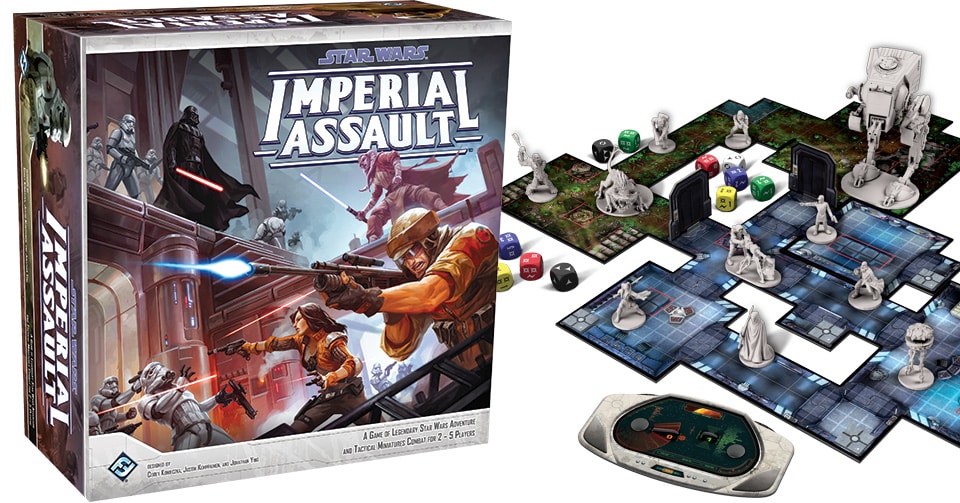
My plea if for standard boxes which save shelf space. Fantasy Flight Games - one of the trend setters in the hobby industry - has given up the iconic "coffin" boxes and switched to square boxes of various heights. I do not know the actual reason behind this move but I can speculate that they are standardizing and making their products gamer-friendly. Think only of Imperial Assault or Descent 2.0.

What is your opinion, do you prefer standard boxes or are you a fan of unlimited creativity and prefer cubical or cylindrical boxes?

2. Rules

Squares, rectangles, A5, A4, letter... the rules is modern games are all over the place. We at NSKN tried our own standard, 285x285mm booklets which are roughly the size of the box. It was or choice for the past 2 years because it allows large graphic examples, the page can be divided into 2 or 3 columns according to needs and it is cost effective.

Cost effective is one of the keys for small publishers like us to succeed. Once we evolved past the point of mere survival (as a company) we had the luxury of rethinking our publishing paradigm and look again for better solutions.

I have been advocating for "our size of the rules" for quite a while until I have recently made an experiment of my own: I took the rules of a random game, put them in both the large square format and A4 (which is almost the same as letter size) and read through them timing myself. Reading the same amount of rules text in A4 format took me about 25% less time. Therefore, the rules of our next game are coming in A4 format, even if that adds a few cents to our production costs.

Which is your preferred rules format? Do you even have one? Is this a key aspect for you when it comes to buying or even playing a game?

3. Boards

This is the point where the discussion gets complicated.

Having analyzed 50 games with non-modular boards published after 2012, I found the following distribution: more than 50% are a 4-fold square or rectangle, 30% are 6-fold rectangles and the rest are... all over the place. When it comes to modular boards, the most common shapes are rectangles, hexagons and starred hexagons, but the distribution here is too difficult to assess because of the wide range of options. Furthermore, less and less of modern board games have an actual board, with German style games sticking more to the original conservative model with an actual board.

I mentioned before that the designer in me wants a giant game board. I have spoken to a few manufacturers and the largest single piece board they can make is 100 x 70 cm and this is not really what I had in mind. Anything beyond that would require all kinds of non-standard "stuff" (I was afraid to ask) and the price would increase five to ten fold for a board just 1.5 times as large.

Comparing boards with the same total area, a 4-fold cut is 30% cheaper in average than a 6-fold cut thus the industry preference for the former. Even when it comes to ergonomics and table space, a square 4-fold cut seems preferable. And yet in Versailles we went with a larger 6-fold board very close to the manufacturer's upper limit because it suited better the game's needs. My inner fight between the designer and the publisher was a clear victory for the designer, while the publisher saw the margins decreasing under his eyes.

Using any standard game board will also save significant costs with the cutting knives when manufacturing with an established large board game factory. For small publishers saving this kind of money may very well make a big difference.

Modular boards offer a greater flexibility and sometime much greater replay value. They do not necessarily increase the manufacturing costs, but they usually do. Yet more and more designers and publishers walk this road, because creativity is no longer limited by a rectangle.

So... what is you view on game boards? With or without? Modular or classic? Does this aspect even matter when it comes to your liking and buying games? 


Conclusions?


Writing for quite a while now, I have only covered about half of the topics I had in mind. So. I'd love to see your opinions and I'll resume my train of thought next week.


__________________
FIND OUT MORE NSKN official website Facebook  | BGG
Follow us on Twitter: @NSKNGames