Showing posts with label Praetor. Show all posts

Thursday, August 27, 2015

A Boardgaming Hobbit

Multiplayer solitaire. Two words that more often than not are used these days to condemn a game, as if automatically making it somehow worse than any a design that will have players at each other’s throats in a matter of minutes – or at least make players fight tooth and nail for scarce resources or territories.

Multiplayer solitaire. Two words that more often than not are used these days to condemn a game, as if automatically making it somehow worse than any a design that will have players at each other’s throats in a matter of minutes – or at least make players fight tooth and nail for scarce resources or territories.

Would you like to read more? We're moving to the New NSKN Blog. You will find the rest of this article here. Oh, and do tell us what you think of our new blog!

__________________
FIND OUT MORE NSKN official website Facebook  | BGG
Follow us on Twitter: @NSKNGames

Thursday, August 20, 2015


The concept of player elimination is a thing of the past. Unless we’re talking about games that are short, random and light – or about “classics” like Monopoly – straight up elimination is gone from most European and American style games these games. Or is it gone in name only?

Would you like to read more? We're moving to the New NSKN Blog. You will find the rest of this article here. Oh, and do tell us what you think of our new blog!

__________________
FIND OUT MORE NSKN official website Facebook  | BGG
Follow us on Twitter: @NSKNGames

Thursday, May 14, 2015

Plastic vs. Wood - Pros and cons of standardizing in board games (III)

Some time ago we started a discussion about standardizing board game components.
Originally I wanted to debate the pros and cons of plastic vs. wood, as many games offer the design space to choose between these two types of material, but then I realized that was a much to narrow topic. So, let's take a look at plastic and wood and their advantages and disadvantages and where and how do they fit best.

Custom Tokens


One of my first board games was Agricola, a classic and former BGG top ranked game. I was lucky enough to find a copy in Romania back in the day, when board games were as hard to find as gems. A few years later I saw a more recent edition of the same game. With the same rules, the new edition of Agricola triggered a completely different feeling because the token were personalized. The sheep were no longer white-ish cubes but tiny sheep, the grains were no longer yellow discs but little yellow grain-like custom wooden tokens and the cows looked like... cows! And yet the game played just as well with the old tokens.

Do you think that custom wooden pieces add value to a board game? This is the first tough question I want to ask today.


Custom tokens in Euphoria: Build a Better Dystopia
source: BoardGameGeek

In my personal opinion they do, but like every good thing, it comes with an ugly hidden part. Custom tokens are more expensive than regular plain old cubes, discs and meeples. The added value is there, but it comes with a cost which is reflected in the final price of the game. Without going through the whole pricing philosophy, I can give you a simple example: Versailles, with an $55 MSRP - a game printed in 6000 copies - would have had an MSRP of $67.5 with custom wooden tokens. 

So it all comes down to this: would you rather pay a bit more for custom wooden token or settle for the lowest possible price and play with cubes and discs?

Before you answer this question, please take a look at Euphoria to see some of the best custom token in a board game. For me that game would not be the same with plain wooden tokens.


Plastic tokens


There's a whole new universe of tokens made of plastic. I personally discovered this rather late, a few years ago and at NSKN we have not taken advantage of this discovery yet.


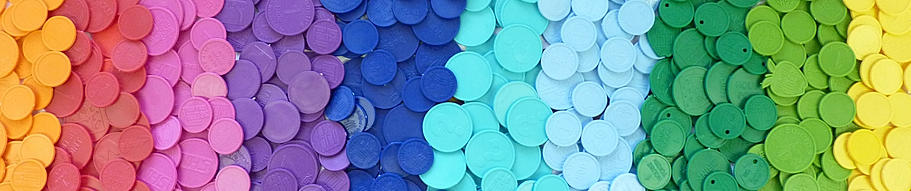
Plastic tokens
source: plastictoken.co.uk

Regular plastic tokens are significantly cheaper than wooden tokens of the same size. But the key word here is regular. I We could easily replace the wooden resource cubes in Praetor with plastic cubes of roughly the same color. The same for Versailles. But the million dollar (actually just $5K) question is: how would you feel seeing plastic resources in a game about ancient Rome or medieval France for just a few bucks less?

Anyone who has played board games by Martin Wallace will know his "trademark" plastic coins which look a little like the ones in the image above but worse. I personally do not mind them, they seems to add a certain charm and to his games, but I know many who find them "too cheap". On the other hand, the plastic gems in Ascension look and feel great and I don't know anyone complaining about them.


It is probably a matter of taste - whether one likes plastic tokens or not - but they definitely did not become mainstream yet. My bet is on the gaining ground because they are cheaper than wooden tokens, they are even more solid and they can come in almost any color.

There is only one downside: plastic tokens require molds which are expensive, so without making tens of thousands of copies of a game, custom plastic tokens are not really an option.

So, how do you feel about them? Is plastic a real competitor for wood? Would you rather stick to the "classic" cubes and discs or do you see added value in custom tokens, plastic or wooden alike?


__________________
FIND OUT MORE NSKN official website Facebook  | BGG
Follow us on Twitter: @NSKNGames

Tuesday, February 24, 2015

Pros and cons of standardizing in board games

Standardizing - yay or nay?


To even begin the discussion about standardizing game components, we need to ask ourselves if this is an actual improvement.

Having dedicated lately more than the fair share of my time to publishing rather than designing, I realized that there is a downside of standardizing - it kills some of the creativity of designers (myself included) on the altar of delivering a marketable, user-friendly, industry standard product. The designer in me is trying to fight the other side of my board gaming personality (the publisher) screaming for more freedom and less standard components. 

I - the designer - wish to have a giant board in one of my upcoming titles depicting a detailed map of the world, something which would make the War of the Ring giant board seem average, but I - the publisher - will most likely deny this request on ground of being unreasonable, too expensive and almost impossible to manufacture.

And that's not all... I - the gamer - had the pleasure of opening 46 game boxes bought in Essen and some of them gave me great joy of discovering clever assembly mechanisms and cute little tweaks which made some games special right of the box, while some others had some of the most twisted annoying components that went straight to the "I am not emotionally equipped to deal with this" shelf.

So, perhaps there's a middle ground and an agreement can be sought by the dreamy designer, the pragmatic publisher and the exigent gamer. 

Almost two years ago when NSKN Games was even younger than today, we decided to approach board game publishing with a specific set of mind - making each game component as functional as possible and packing everything in the least possible amount of space.


Same size boxes


In a post on the NSKN Games website called "Less is more" we described this "discovery" and its core principles. We adheres to these principles fully and Exodus: Proxima Centauri (revised edition), Praetor, Progress: Evolution of Technology and Versailles - board games published by NSKN Games since then - are all built accordingly. Our two upcoming titles for the first half of 2015 - Exodus: Edge of Extinction and Mistfall - are following the trend and will have the same ergonomic design. But is this all we can do? The short answer is no, there's definitely room for improvement and this is what I want to explore together with you today.


Game components one by one - standard or not?


1. Game box - it's the first thing you and I see and 90% of the times the box is the decisive factor in our interest and later buying the game or not.


Image source: BoardGameGeek
My first few games were of various sizes and shapes, from the standard square Ticket to Ride box, to the monstrous Twilight Imperium "coffin" and the tiny Catan Card Game. Through the years I have become pickier and the box of Dungeon Fighter caused me head aches because it's just marginally larger than the standard square and yet it does not fit on my very standard IKEA shelves... so I had to let it go.


Image source: thebattlestandard.com
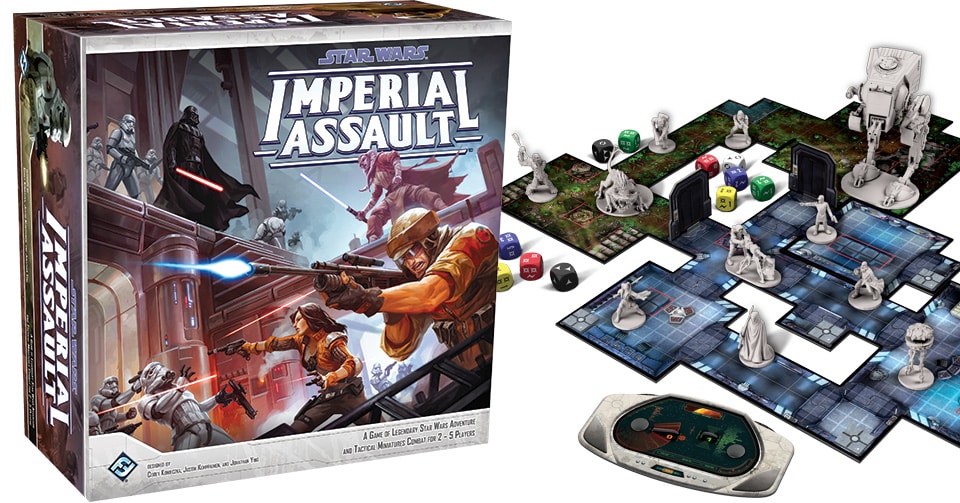
My plea if for standard boxes which save shelf space. Fantasy Flight Games - one of the trend setters in the hobby industry - has given up the iconic "coffin" boxes and switched to square boxes of various heights. I do not know the actual reason behind this move but I can speculate that they are standardizing and making their products gamer-friendly. Think only of Imperial Assault or Descent 2.0.

What is your opinion, do you prefer standard boxes or are you a fan of unlimited creativity and prefer cubical or cylindrical boxes?

2. Rules

Squares, rectangles, A5, A4, letter... the rules is modern games are all over the place. We at NSKN tried our own standard, 285x285mm booklets which are roughly the size of the box. It was or choice for the past 2 years because it allows large graphic examples, the page can be divided into 2 or 3 columns according to needs and it is cost effective.

Cost effective is one of the keys for small publishers like us to succeed. Once we evolved past the point of mere survival (as a company) we had the luxury of rethinking our publishing paradigm and look again for better solutions.

I have been advocating for "our size of the rules" for quite a while until I have recently made an experiment of my own: I took the rules of a random game, put them in both the large square format and A4 (which is almost the same as letter size) and read through them timing myself. Reading the same amount of rules text in A4 format took me about 25% less time. Therefore, the rules of our next game are coming in A4 format, even if that adds a few cents to our production costs.

Which is your preferred rules format? Do you even have one? Is this a key aspect for you when it comes to buying or even playing a game?

3. Boards

This is the point where the discussion gets complicated.

Having analyzed 50 games with non-modular boards published after 2012, I found the following distribution: more than 50% are a 4-fold square or rectangle, 30% are 6-fold rectangles and the rest are... all over the place. When it comes to modular boards, the most common shapes are rectangles, hexagons and starred hexagons, but the distribution here is too difficult to assess because of the wide range of options. Furthermore, less and less of modern board games have an actual board, with German style games sticking more to the original conservative model with an actual board.

I mentioned before that the designer in me wants a giant game board. I have spoken to a few manufacturers and the largest single piece board they can make is 100 x 70 cm and this is not really what I had in mind. Anything beyond that would require all kinds of non-standard "stuff" (I was afraid to ask) and the price would increase five to ten fold for a board just 1.5 times as large.

Comparing boards with the same total area, a 4-fold cut is 30% cheaper in average than a 6-fold cut thus the industry preference for the former. Even when it comes to ergonomics and table space, a square 4-fold cut seems preferable. And yet in Versailles we went with a larger 6-fold board very close to the manufacturer's upper limit because it suited better the game's needs. My inner fight between the designer and the publisher was a clear victory for the designer, while the publisher saw the margins decreasing under his eyes.

Using any standard game board will also save significant costs with the cutting knives when manufacturing with an established large board game factory. For small publishers saving this kind of money may very well make a big difference.

Modular boards offer a greater flexibility and sometime much greater replay value. They do not necessarily increase the manufacturing costs, but they usually do. Yet more and more designers and publishers walk this road, because creativity is no longer limited by a rectangle.

So... what is you view on game boards? With or without? Modular or classic? Does this aspect even matter when it comes to your liking and buying games? 


Conclusions?


Writing for quite a while now, I have only covered about half of the topics I had in mind. So. I'd love to see your opinions and I'll resume my train of thought next week.


__________________
FIND OUT MORE NSKN official website Facebook  | BGG
Follow us on Twitter: @NSKNGames

Friday, October 24, 2014

First post-Essen thoughts and some more pictures

Essen 2014 was awesome! So many people we had seen in the past came by our booth again, lots of handshakes and hugs made Essen feel like a gathering of old friends, brought together by teh same passion - board games.


For the first time in the history of NSKN Games, we sold out in Essen having more than one product at our booth and the quantity was not negligible. Delivering more than 200 Kickstarter rewards while serving a lot of customers was another big challenge, but we seem to have passed the test.

It's hard to draw all the conclusions after just a few days, but the whole NSKN team has returned with a very good feeling. Next week we'll have to look more in depth into what this event represented for us and we'll come back and share the conclusions.


__________________
FIND OUT MORE NSKN official website Facebook  | BGG
Follow us on Twitter: @NSKNGames

Sunday, October 19, 2014

Essen 2014 - day 2 & day 3

This year's Spiel Essen turns out to be a truly amazing experience. We continue our story in images with photos from day 2 (Friday) and day 3 (Saturday).

Day 2 - what was supposed to be the slowest day...

Happy owners of brand new Progress: Evolution of Technology

Explaining Progress

...and playing Versailles

Happy girls

Day 3 - the "sold out" day

Hard thinking and... watching

Progress countdown on Saturday morning

Game delivered!

That's what we call original

Around 11;00 AM

One of the last copies of Progress delivered at Spiel

4 copies left

and just a few minutes later...

With Progress sold out, we still invite you to visit our booth. We have a few copies of Praetor and a few of Versailles for Sunday.


__________________
FIND OUT MORE NSKN official website Facebook  | BGG
Follow us on Twitter: @NSKNGames

Friday, October 17, 2014

Essen 2014 - setup and day 1

Being in Essen for Spiel is always an amazing experience, but this year's first day has exceeded our expectations by far. Since another big day is ahead of us in several hours, we'll let the pictures do the talking...

Day -2: leaving home

Leaving friends at home...

Day -1: setting up the booth

No less than 10 pallets of games made it to our booth in Essen

The setup day was looooong

... and it included climbing a giant ladder

Day 0: the day before the official opening

Delivering Kickstarter copies of Progress

The game have slowly found their places on shelves... and everywhere else

Game previews at the BoardGameGeek booth

Day 1: Spiel '14 Essen has finally starter... full speed ahead

Playing tables

The stock of Progress is running low from the morning hours... should we have brought more games?

Versailles

Progress: Evolution of Technology


And Versailles again

__________________
FIND OUT MORE NSKN official website Facebook  | BGG
Follow us on Twitter: @NSKNGames

Sunday, October 12, 2014

Designer Diary - Praetor (part II)

To read the first part of this designed diary please follow this link.

Praetor 1.1


Decreasing the number of tiles was an obvious choice. The game play was sound, but simply too long. Making less tiles of one kind (e.g. Gold Mines which would provide currency for players) did not decrease the number of choices, it simply made the game easier to grasp. The first “hair cut” left Praetor with less than 60 city tiles.

To avoid any scalability problems from the very beginning, I created a core set of about 25 city tiles which were used for the 2-player games and with each extra player several more tiles would be added. With each extra player there were more workers and more resources in the game and thus the play time would not increase significantly since more workers plus more resources meant faster building.

The one test I was the most afraid of was the first 6-player game. I knew that in theory the game should scale nicely, but I also knew that sometimes there’s a big difference between theory and practice. To increase the difficulty of the challenge even further, I chose a group of very casual gamers, people who would usually settle for game as complex as Monopoly. To my surprise, the game only took two hours and the feedback was overwhelmingly positive. Version 1.1 had passed its most difficult exam and the game was deemed ready for mass testing.

Nürnberg 2013 and the long months of testing


I had big doubts whether to present the prototype of Praetor to W Eric Martin of BoardGameGeek at the Nürnberg Toy Fair or not. I knew that showing a rough version with no graphic design could trigger negative opinions, but the team decided to go for it and see it would spark any interest. And it did!

Praetor 1.1 hex tile

It suddenly became a lot easier to find groups of testers and it also created the right expectations. People were playing an illustration-free game and they were giving feedback only to the game mechanisms which is exactly what I needed.

After I became convinced that the flow of the game is right, I added the last piece of the puzzle, the mechanism of tile placement. Every corner of each city tile was painted in one of four colors. When a player would build a new tile (district), he would also have to choose its place in the city. The more corners matched the neighboring tiles, the more extra points that player would get. It was another level of strategy and it also made the modular board look nicer, at least in my mind since there was not even a hint of illustration on the city tiles.

We took Praetor to a few small conventions and to the UK Games Expo in May 2013 and slowly drafted what looked like the final version. The last major decision was to limit the maximum number of player to 5. I won’t get into many details, it had a lot to do with the tradition in the industry, many games of this genre being limited to 4 or 5 players and a bit to do with adding diversity and limiting the chaos with a large number of players.

The last significant change in the game play was dropping the concept of initiative. At first, each tile would provide an amount of a resource called “initiative” which determined the order of play. This allowed the most developed player to play first in a subsequent turn, hence no catching-up mechanism. With the initiative out of the way, every turn the order of play was based on the number of favor points, from the lowest to the highest. I knew that it was a common thing in board games, but at that moment I felt like I discovered the wheel because the last shadow of concern related to the imbalance of the game disappeared.

Summer, public display and the first days of winter


We announced that we’d present Praetor in Spiel ’13 Essen quite long before we had any final graphics prepared. After extensive feedback, I was finally convinced to give up the hexes and use squares. The game play did not change, the tile placement mechanism became simpler and the work of the illustrator and graphic designer significantly easier. I had to accept that I was in love with my own concept and that I had to give up and embrace the fact that when many people tell you that you’re wrong it’s probably true.

One day last autumn I was chatting with a good friend on Skype and with a very casual voice he told me that he has heard of another game fresh on Kickstarter which employed “the same idea with worker which get experience”. I turned first red, than white, thinking that the last year of my life was in vain. How could this happen? Is the project dead? I don’t stress easily, but I must admit that I don’t remember much of those next ten minutes. I looked for the rules, browsed through, had a cold glass of water and ultimately calmed down. It was a different game (and I apologize for not even remembering the name, all I can recall is that it did well with its crowd-funding) and in my mind there could not be any sign of confusion. I finally replied with arrogance “great minds think alike” but I must confess that I had cold sweats just thinking that I took too long to design a game that I can be proud of and someone else beat me to it.


Illustration for Praetor City Tiles

Well, we made the deadline for Essen with all the illustration for the city tiles ready. On top of that, we increased the size of each city tile from 2.5 x 2.5 in to 3.2 x 3.2 in so the illustrations are more visible. Even as a prototype Praetor got a lot of attention and we had many offers from people willing to purchase our only prototype. I was convinced we were on the right track, so I spent the late autumn and the first days of winter working on the final rules and making sure that we’d have the final graphic design to complement the beautiful illustrations.

 Ready, Set, Go!

Praetor punchboards during the manufacturing process
In April 2014 we were able to touch the final product. With yet another graphic design update made by a professional designer, we released Praetor in seven languages and over 7500 copies, making it the largest title from NSKN Games to date.


__________________
FIND OUT MORE NSKN official website Facebook  | BGG
Follow us on Twitter: @NSKNGames

Thursday, October 9, 2014

Designer Diary - Praetor (part I)

I must start by confessing that I am an avid euro-gamer and that worker placement games rank very high in my preferences. It has been my dream as a board game designer to make such a game myself, one that will stand out between the many good games of this genre.
Praetor is a strategy game evolving around the worker placement mechanism, set in the Roman Britannia. Even though it is not the most complex game I have ever designed (that honor is still held by Exodus: Proxima Centauri), Praetor is the game I have been working on the longest and the game that got most of my attention over the past 18 months.

Ever since I started playing modern board games and fell in love with “euros”, I felt that one thing was constantly lacking, the fact that no matter how much I used a worker he would never gain any experience. It was always the same worker, no better and no worse than at the very beginning of the game. I thought to myself that this is one idea worth considering and if I would ever design such a game it would overcome this lack of realism in worker placement games.

Ancient history


I started working on Praetor in August 2012 with this single idea in mind, to create a mechanism in which the workers would slowly gain experience. My first worker was represented by a fairly large wooden disc and his experience by additional wooden cubes. Don’t get scared just yet, seeing the ridiculous amount of parts a player would have to manage with just a pair of workers, I soon realized that there’s a reason for which in most games workers are wooden meeples or cubes or discs or, at best, plastic miniatures. I was not very proud of this initial idea so I chose to stay quiet and “forget” to share this even with the members of NSKN Games.
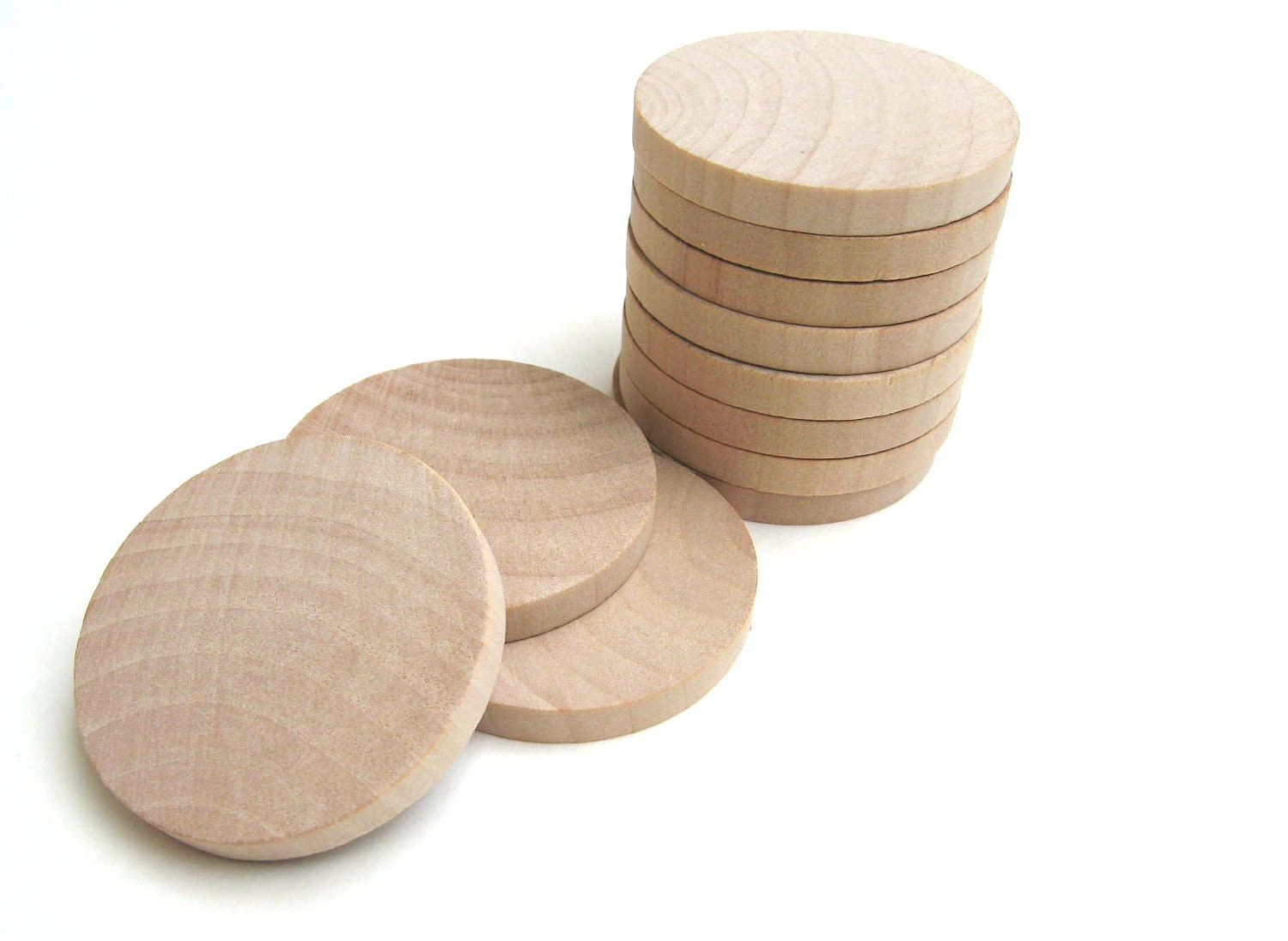
The first concept of experience (image source: etsy.com)

Shortly after dust had settled over Essen 2012 and the euphoria of such a great event, I realized that dice are the most elegant implementation for the experience of workers. My initial idea was to simulate real life and look for a non-linear evolution of the experience in time, but I did not want to push my luck and people mathematical skills above an acceptable limit. So, I went with the dice and I started building the whole game around them.

By December I had already figured out most of the concepts of the game. Since it all started with an abstract idea - workers gaining experience - I went along the same path and built the game around abstract concepts. The workers would help generate up to 5 – 7 resources which would be used to build “stuff”. Now, “stuff” was way too abstract and I went with the idea of buildings. In just a few days I had a list of 60 buildings which would all be tied together, allowing the exchange of resources for points, give special abilities and allow players’ workers to gain experience. The mathematical model quickly became very complex and difficult to follow. The first time I presented the concept to the outside world I lost people about half way through the explanations. Abstract games tend to have simple rules and my project was far from that.

The search for the theme

When it came to finding a theme, all I knew at first was that I would not name my game after some famous medieval city or country and the workers would not be farmers. It’s not that I don’t enjoy farming in Agricola, but there are simply too many games with in this limited universe. Since I love history and for a worker placement game a historical theme is a plus, I started a process of researching relevant moments in our past when people built something… relevant. Starting in the ancient times, I went through the world history and the first thing that I stumble upon and liked was the Chinese wall. 

Great Wall of China (image source: shedexpedition.com)

Sadly, my knowledge of that specific part of the world was limited so I had to admit defeat and look for something new. Just a few hours later I rediscovered the Roman Empire with its impressive coliseums, aqueducts, amphitheaters and legions and it felt like a revelation – that was the theme I was looking for.

Hadrian's wall (image source: Wikipedia)

The process of “dressing up” abstract concepts into Roman constructions was very intense and I will not bore you by describing every step of the way. What I can tell you is that I had to discard more than half of the mechanisms I had built and to add a few more to make everything fit together like a giant puzzle. And speaking of puzzles, that was also the moment when I discovered that “the game” would also be a tile-laying game.

I called it “the game” because back then it was still missing its title. My first impulse was to name it Caesar, but that would create huge confusion and mix-up with computer games with a similar name and theme. Plus, it would not fit the theme. I knew that players would strive to become the “big boss of a Roman city” and that position was either a Magister or a Praetor. I chose between the two and, from that moment on, my project became Praetor.

Praetor 1.0

Because of my background of computer programming, I have the habit of numbering every single version. Praetor 1.0 was the first prototype and probably the biggest breakthrough because every relevant abstract concept found its way into this themed board game prototype.

The core concept of Praetor did not change ever since, even though I put it through “fire and axe” in multiple sessions of play-testing over more than one year. Every player starts with three workers which he uses to build new districts into the city or to activate already built districts and thus gain various benefits, usually resources and favor points. Players can recruit new workers while the old ones gain more experience and retire, being a burden rather than an advantage. At the end of each turn, player will pay wages for their active workers and pension to the retired ones – a system which resembles the modern world but was first defined as a similar concept by the Romans.

Praetor 1.0 player board

What I must admit is that Praetor 1.0 was quite heavy, significantly more than I realized in my solo tests. The very first 2-player game took longer than one hour and the first 4-player game… well, I won’t really say because I don’t want to scare you off just yet.


Hexes from the first prototype

Praetor 1.0 was meant for 2-6 players and had almost 85 hexagonal tiles. Each tile had a cost to build, an instant reward made of a number of points and some initiative and an activation area. The activation area contained a benefit which was sometimes dependent on the experience of the worker and a cost that would be paid by the player activating the tile to the player owning the tile. With the exception of the initiative, every other concept can be found today in the box.

That's all for today, stay tuned tomorrow for part II!


__________________
FIND OUT MORE NSKN official website Facebook  | BGG
Follow us on Twitter: @NSKNGames