Showing posts with label NSKN Games. Show all posts

Tuesday, July 14, 2015

A dragon's tale (part I)


Simurgh was the first game ever picked up by NSKN Games after a pitch, and it is the first ever project in which we had to work with a designer who was not part of NSKN Games.

It all started at the Nurnberg Toy Fair back in 2013. It was our first appearance at a large fair besides Spiel and it was as surprising as our first presence is Essen. A lot of famous designers come to Nurnberg to present their new ideas because unlike Essen which offers some incredibly busy four days, Nurnberg it 6 days long and quite relaxed, with fewer visitors and time to catch a breath.

That's where we met Pierluca Zizzi, a charming Italian game designer who pitched a "board building game with some awesome worker placement mechanisms and...dinosaurs", and we were intrigued. The game was sharing some game design principles with one of Pierluca's other designs, so we had to wait for another 5 months to actually play the game.

Our first game of Simurgh (back then Mu) took place in GobCob later that year. We said yes to the game the very same day and we brought along the prototype for further testing, but we already knew known that we had found a gem.

You need to know a few things about the earliest prototype we've seen. It did not feature dragons, but dinosaurs. Everyone, including the designer, knew that dinosaurs are not there to stay, nevertheless we had lots of fun imagining dragon... pardon me... dinosaur raiders foraging through some ancient forest. Dinos are not a bad thing - take a look at Evolution or Dominant Species - they were just totally out of place, not fitting at all with the game mechanics. But the game itself was so good that we decided on the spot to publish it after we found the perfect theme.

It wasn't long until Simurgh found its name and theme. It took some 12-hour car ride, a ridiculous amount of emails (if you have not tried brain storming by email, do not miss this unique opportunity... just kidding) and a few months later we were ready to dress the game into some beautiful artwork and present it in Essen. That was still back in 2013.


Dragon sketch by Enggar Adirasa

A legitimate question at this point is "Why dragons?" and what does the name of the game mean. We must admit that we were somehow conditioned by the original dinosaur theme and we were not able to shift our thinking into a completely different plane, so we gravitated around "stuff which can fly, stuff which can be ridden" and "a mythical universe", "of man and... (add word here)". Add to this mix another key ingredient - we like dragons  -  and we had the cocktail ready for a dragon themed game. The truth is that all the game mechanisms fit perfectly with the theme we chose and we were very happy to see the metamorphosis of Mu into Simurgh.

Our dragons were never meant to be evil. Scary - yes, by all means, but never evil. The legends of many peoples are filled with dragons, from Asia to South America and from Europe to Africa. We search the mythology for a perfect match and the Persian Simurgh came as the obvious choice.

Stay tuned for the second part of the story, coming up in a few weeks.


__________________
FIND OUT MORE NSKN official website Facebook  | BGG
Follow us on Twitter: @NSKNGames

Thursday, June 18, 2015

4 pieces of advice for first time Kickstarter creators

We've recently proven that a complex project involving lots of cardboard, dice, wood and plastic space ships can be delivered on time (actually early, but that is beside the point). It's all about hard work and proper planning. So, if you decide to crowd-fund, it's up to you to do the same or better.

I am going to keep this short and simple, as what I am about to say has been said before and will probably be the same sentence that any experienced Kickstarter creator will give any "first-timer": deliver!

Advice no. 1: Plan to deliver! Ideally this should done be on time, but late is still better than never. US authorities are taking a closer look at creators who do not deliver and you may face legal action. I need to clarify this... if you're what people define as a "normal person", you will think it is very odd to read these few lines, but NSKN Games has received numerous messages from creators-to-be with questions such as "Do I have to deliver? What happens if I don't?". Now, there is an "official" answer, the FTC takes legal action against creators who mislead and mismanage.


Source: fx24seven.com


Advice no. 2Kickstarter is hard work, not easy money. Start with this idea in mind and the countless challenges you face will seem a lot easier. Well, maybe not a lot, but somewhat easier :)


Source: www.associatedlearningsystems.co.uk


Advice no. 3: The key to success is good planning. This applies to pretty much everything you do in life, but for Kickstarter creators this is especially true. Sound common sense is your first tool, but there are plenty of resources in the digital world which can help you crack open the secrets of strategic planning and project management. You can also hire a professional to guide you through the whole process and this may very well pay off if you are unwilling or don't have the time to learn everything there is to learn, but this is just back-up.


Source: blog.valpakfranchising.com

Advice no. 4: Do your homework. It is very unlikely that you will reinvent the wheel, so take a look at some of the successful projects and see what they have done right. Check their campaign pages, but do not ignore the updates and comments section, they often reveal more than the main project page itself. There are thousands of successful projects so you will most likely be overwhelmed by the variety of approaches. Every single Kickstarter creator will tell you that their way is the right way. Your quest is to discover yours. "Steal" the best ideas from past successful projects and adapt/improve them to your vision. It sounds easy enough, but it's a lot of hard work. 

If these pieces of information sound generic, we will return with some more advice specific for board games.

__________________
FIND OUT MORE NSKN official website Facebook  | BGG
Follow us on Twitter: @NSKNGames

Thursday, June 4, 2015

Don't you want to breed dragons?


Yes, our next board game is all about breeding dragons! 

We've been quite busy this year with two successful Kickstarter projects (Exodus & Mistfall), but we have been working in the background to finalize a project we've been long dreaming of...

If you played Hyperborea and loved it, you must know that Pierluca Zizzi is the "brain behind the game". He is a talented Italian designer with several published games and he first showed us Simurgh two years ago in the Nurnberg Toy Fair. We've been impressed and decided to take the game on the spot.


Cover work in progress by Odysseas Stamoglou

To make things even better, the cover art will be signed by Odysseas Stamoglou, the same amazing artist who has been responsible for Exodus: Edge of Extinction, Versailles or Among the Stars.

So, what is Simurgh? It's a worker placement board game with a hint of board building, it's also a race game, highly competitive and... it has dragons. Should we say a more than you get to breed dragons and some of your workers are in fact dragon riders?


__________________
FIND OUT MORE NSKN official website Facebook  | BGG
Follow us on Twitter: @NSKNGames

Tuesday, May 19, 2015

Prototypical Influence

There are mostly two things I remember vividly from presenting the first prototype of a certain game that has since fallen into oblivion. The first was how initial reservations of people who sat down to play it would change into all out enthusiasm by the end of the third or fourth turn. The second was the question that was seemingly asked by every other person who sat down to play: “Are you really allowed to use Magic layouts for your own game?”

Three stages of prototyping for Mistfall.
During the last two weeks I talked about making a prototype of your game, starting off with advising on what not to do when preparing a prototype for a potential publisher, and then sharing my own tips (part one and part two) on giving your game idea an actual shape in the real world. Before finishing off the practical advice series, I’d like to take a small detour to discuss one more aspect of prototyping, and that is how the form of your prototype influences the way your testers will react to it - and what you are probable to get for a basic or a "good looking" prototype.

I’ve already talked about why it is not the best idea to put in too much work into the art and graphic design part of your prototype. But aside from using up time that could be better spent on perfecting the actual game, there is also the matter of how your testers will perceive your prototype – and how willing they will be to share their ideas on it with you. 

Simply put, if your prototype looks like an almost finished game, chances are that some of your testers might doubt themselves more than your design. This may lead to them refraining from voicing their complaints or ideas, just because visually the game looks like a ready to go product. Obviously, this will influence only some people, but still, if you want more sincere responses, you should probably go with a more basic looking prototype.
Here's some basic prototyping components, just for good measure.
On the other hand, building a serviceable but simple, very much “work in progress” prototype makes people more eager to actually share all their thoughts, as they receive a visual cue that what you gave them to play with can still be modified. When you're still running basic playability tests, it's generally better to have more to work with (and weigh out) than to falsely believe that your game is perfect. And some people might be easily convinced that something they would perceive as a flaw, is actually a feature, since the game looks "so completed".  

Now, if you’re still somewhat perplexed by the Magic story in the first paragraph, let me also elaborate on that. To make my life easier, I used a free editor with Magic: The Gathering layouts to create all the cards for the game. And although I would start each and every presentation with saying: “None of the components you see here, none of the artworks, no graphic design elements or symbols are final”, people would still ask me if this is really the layout I'm going with for the final game.

With that in mind, it’s probably good to remember that no matter what you say, the actual shape of your prototype will do more talking than your mouth. And for that reason, when you want actual criticism, show people a prototype that is as basic as humanly possible – and when you want some love for the game (maybe because the testing period is done), go with the almost-finished looking one. My experience tells me that it works almost every time.
__________________
FIND OUT MORE NSKN official website Facebook  | BGG
Follow us on Twitter: @NSKNGames
Thursday, May 14, 2015

Plastic vs. Wood - Pros and cons of standardizing in board games (III)

Some time ago we started a discussion about standardizing board game components.
Originally I wanted to debate the pros and cons of plastic vs. wood, as many games offer the design space to choose between these two types of material, but then I realized that was a much to narrow topic. So, let's take a look at plastic and wood and their advantages and disadvantages and where and how do they fit best.

Custom Tokens


One of my first board games was Agricola, a classic and former BGG top ranked game. I was lucky enough to find a copy in Romania back in the day, when board games were as hard to find as gems. A few years later I saw a more recent edition of the same game. With the same rules, the new edition of Agricola triggered a completely different feeling because the token were personalized. The sheep were no longer white-ish cubes but tiny sheep, the grains were no longer yellow discs but little yellow grain-like custom wooden tokens and the cows looked like... cows! And yet the game played just as well with the old tokens.

Do you think that custom wooden pieces add value to a board game? This is the first tough question I want to ask today.


Custom tokens in Euphoria: Build a Better Dystopia
source: BoardGameGeek

In my personal opinion they do, but like every good thing, it comes with an ugly hidden part. Custom tokens are more expensive than regular plain old cubes, discs and meeples. The added value is there, but it comes with a cost which is reflected in the final price of the game. Without going through the whole pricing philosophy, I can give you a simple example: Versailles, with an $55 MSRP - a game printed in 6000 copies - would have had an MSRP of $67.5 with custom wooden tokens. 

So it all comes down to this: would you rather pay a bit more for custom wooden token or settle for the lowest possible price and play with cubes and discs?

Before you answer this question, please take a look at Euphoria to see some of the best custom token in a board game. For me that game would not be the same with plain wooden tokens.


Plastic tokens


There's a whole new universe of tokens made of plastic. I personally discovered this rather late, a few years ago and at NSKN we have not taken advantage of this discovery yet.


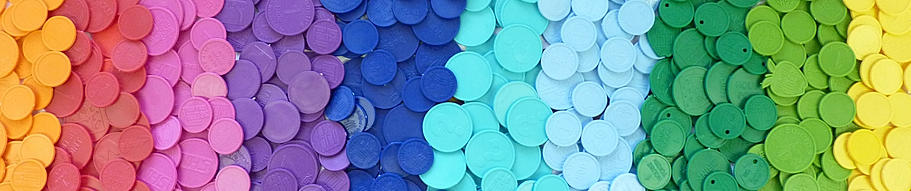
Plastic tokens
source: plastictoken.co.uk

Regular plastic tokens are significantly cheaper than wooden tokens of the same size. But the key word here is regular. I We could easily replace the wooden resource cubes in Praetor with plastic cubes of roughly the same color. The same for Versailles. But the million dollar (actually just $5K) question is: how would you feel seeing plastic resources in a game about ancient Rome or medieval France for just a few bucks less?

Anyone who has played board games by Martin Wallace will know his "trademark" plastic coins which look a little like the ones in the image above but worse. I personally do not mind them, they seems to add a certain charm and to his games, but I know many who find them "too cheap". On the other hand, the plastic gems in Ascension look and feel great and I don't know anyone complaining about them.


It is probably a matter of taste - whether one likes plastic tokens or not - but they definitely did not become mainstream yet. My bet is on the gaining ground because they are cheaper than wooden tokens, they are even more solid and they can come in almost any color.

There is only one downside: plastic tokens require molds which are expensive, so without making tens of thousands of copies of a game, custom plastic tokens are not really an option.

So, how do you feel about them? Is plastic a real competitor for wood? Would you rather stick to the "classic" cubes and discs or do you see added value in custom tokens, plastic or wooden alike?


__________________
FIND OUT MORE NSKN official website Facebook  | BGG
Follow us on Twitter: @NSKNGames

Tuesday, May 12, 2015

If you build it, they will come. Part 2: Boards, Tokens & Dice.


Last week I talked about making cards for your prototype. Continuing the topic of prototyping your game, I’d like to talk about tiles, tokens and dice – and of the importance of cannibalizing other games.
Some basic tools: box cutter, heavy duty scissors, paper glue.

1. Tiles and boards

Making tiles and boards can be as simple, or as complicated and time consuming as you want it to be. Depending on how much work you want to put into your prototype, and on the actual use of a given component, you may either use some cardboard and paper glue, or simply a thicker type of paper you can print directly on.
Mistfall Hero Charters getting ready to be glued on thick cardboard sheets.


Cutting out tiles from a large sheet may be problematic, and you will probably do well to first get a specialist knife (or a box cutter) and something to safely cut on (like a self healing mat). But you can also make your life much easier by using tiles from another game as a base. You can paste over them with your printouts, and possibly trim down to the proper size.
Prototype Praetor tiles, and prototype Mistfall tiles pasted on final Praetor tiles.

As for boards, you can use anything to make them thick – but you can also simply use thick paper for your prototype. Wargames have gone with “maps” instead of boards for years, so if you don’t have anything you could mount your prototype board on, simply don’t mount it. Just use some scotch tape to make sure that smaller pieces don’t separate during game (or print it on a large sheet), and you are good to go.
This Versailles board is here for one purpose only: it will become a prototype board for a new game.

2. Game Tokens

The simplest way to make tokens is not to make them at all. If you need money for your prototype, borrow some coin tokens from another game, or use poker chips. If you need different types of goods you will be trading with or exchanging for victory points, consider simply using wooden or plastic cubes (again, taken from another game or bough from a specialist store). I personally use different types of markers, from wooden disks and cubes, to glass beads and tiddlywinks. You might be surprised what you can find at the florist’s or at a craft store.
Prototype tokens for Praetor and Versailles made using tokens fro other games and trimmed down to size.

3. Custom dice

The easiest way to make custom dice is to find blank dice online, and then either print out and paste the custom faces – or simply use a permanent marker. The second option is not quite as good, as you will most probably be unable to reuse any dice later – unless you paste over what you wrote on them – or even tweak the dice for the current prototype.
Blank dice and some prototype dice made by pasting printouts.

If blank dice are not a viable option, you can also use regular dice to paste over. Although, I strongly recommend using big dice with unrounded corners, as it is much easier to paste on them: you simply cut out squares (instead of circles) and glue them to the die sides. Finally, if none of these options are available, or you need dice other than the standard six sided ones, you can always prepare cheat-sheets, which will translate any numbers from regular dice into specific symbol outcomes (or other numbers). Be aware though, that this option may negatively impact the comfort of playing your prototype.
If you have to use regular dice, choose ones that are least rounded on the corners.

Next time…

I will be talking about some more general tips and tricks, wrapping up my prototyping series. As always, if you have any questions (or there is something more you’d specifically want to know – or add), ask away! Till next time
__________________
FIND OUT MORE NSKN official website Facebook  | BGG
Follow us on Twitter: @NSKNGames

Thursday, May 7, 2015

If you build it, they will come. Part 1: Cards.


A few days ago I talked on the blog about what to and what not to do with your prototype before sending it to a publisher. This time, I’d like to take a step back and talk a little bit about how to actually make a prototype of your game – or at least give you a few useful tips on making some of the most popular components. With this in mind, let's talk about cards.

A lot of games have cards, either as an addition to the board, tokens, cubes and meeples, or as the “main attraction”. Regardless of how important and numerous cards are in your game, you really don’t want them simply printed on a piece of paper. So, unless you are using a professional printing service that focuses on cards, you need an easy way to make them at home – and here’s how you do that. 

1. Get some CCG cards.

Most of us gamers had at one point of our lives (or still have) something to do with a collectible, trading or living card game. Such an adventure usually leaves us with a boatload of old cards, ripe for being used in a prototype of our own game. And if you’ve never played a CCG, or have gotten rid of all your old cards, don’t worry, you can usually get packs of several hundred old cards off the internet for a few bucks (or your regional equivalent).

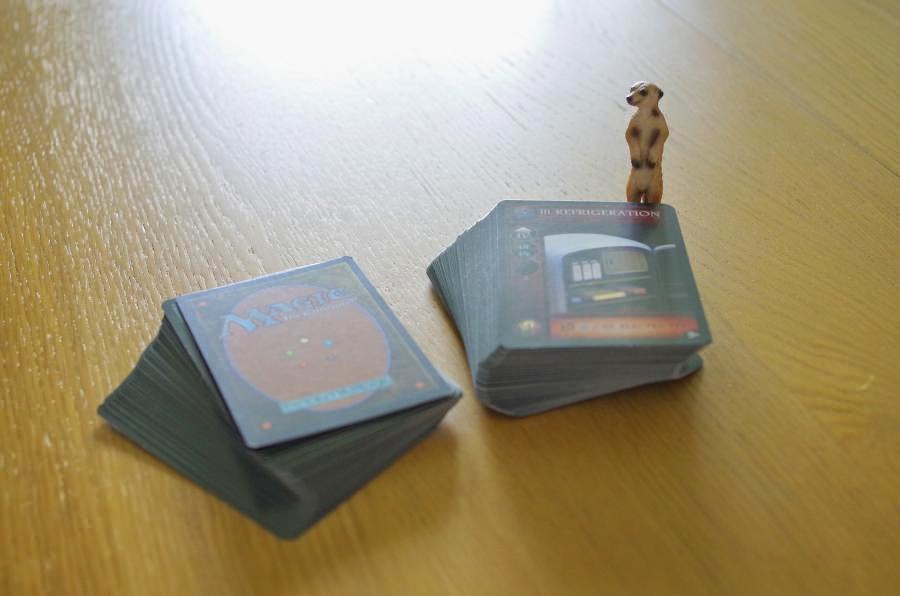
A stack of some CCG cards (Magic) and some CCG-sized Progress cards.

2. Get some sleeves 

Some people like to glue prototype printouts on cards. While the idea is not bad, it has a few downsides. One is that usually the stickers don’t take that well to shuffling. Another is that you will only be able to reuse one cards a few times, as after sticking two or three layers, it will simply become too thick to handle comfortably. By far the best way is to get card sleeves. Even the cheapest will do: you’ll just take a card and sleeve it together with the prototype printout, to create a card that is not only easy to shuffle, but also relatively resistant to some abuse.

Penny sleeves ready for prototyping.

Also, when you want to make critical corrections, you can just toss the old printout and replace it with a new one. Finally, if you’re working on a game with different decks and you need different backs, you may think about slightly more expansive sleeves with opaque, coloured backs. These will allow you to distinguish between different card types easily, and as an added bonus, they will also make you cards slightly stiffer and more durable than penny sleeves.

Different colour sleeves for different decks in your prototype.
 
3. Get some good scissors or a guillotine paper cutter 

This is as simple as can be: if you’re planning on doing a lot of cutting, getting good (preferably long) scissors will make your job a lot easier. Adding a guillotine to your prototype workbench might also be a good idea, although if you’re not planning to assemble cards by the hundreds, long scissors will probably suffice.

My own scissors of choice: long and longer.

4. Use helpful software 

The internet is full of helpful software that is either free, and that allows you to quickly build and print CCG cards. A quick internet search will undoubtedly point you in the right direction. You can also quite as easily use your word processor to build a suitable table, that (after filling it with texts and symbols) can then be printed out and cut into separate cards. 

Rough prototype cards created using MS Word, CCG cards, a laser printer and a pair of scissors.

Different designers have various methods of making their prototypes. What I’ve shown you here is only what I consider most effective – and best fitting my work style. Still, some designers prefer to use business cards they write on by hand, or a professional card printing service (which is a great idea, but I’d advise it only when you know you won’t be making many changes to your cards), and what works for me may not exactly work for you.


Final Mistfall prototype - professional graphic design and printing, plus CCG cards and penny sleeves.

Next time I’ll talk a about tiles, tokens and the importance of cannibalizing other games. See you then!
__________________
FIND OUT MORE NSKN official website Facebook  | BGG
Follow us on Twitter: @NSKNGames

Tuesday, May 5, 2015

The thing with prototypes

I’ve recently heard that with specialist software and high quality printing services so widely available, there is no reason (and no excuse) for a prototype to look much worse than a finished game, and that designers should really make their prototypes look great to improve their chances of being published. Ladies and gentlemen, that is bad advice.

Image Source: BoardGameGeek

During the last few months at NSKN Games I’ve had some prototypes pass through my gaming table. Some of them looked really impressive, with “near final” artwork and graphic design. Some of them looked merely serviceable, with simple clipart or symbols representing different game elements. And we’ve both accepted and rejected games regardless of how lavishly or how simply their prototypes were produced. 

Now, I cannot speak for all publishers in the world, as maybe some of them will have a different approach to prototypes, but I’m still relatively certain that the following list of things you really don’t need to do (and a few things you most certainly do need to do) is one that will work with a lot of publishers. So, here we go: 

Do not overproduce your prototype. We will not be more impressed if you go with fancy stuff instead of simple stuff. We will honestly be looking at how your game plays, not at how your game presents itself on the table (in its prototype incarnation). Believe me when I say we’ve seen a lot of games, and we will be looking at mechanisms and ideas, not at shiny things. 

However, do make sure that your prototype is serviceable, easy to read and complete. Even the most lavishly produced copy will fail to engage us, if simply playing it seems the biggest challenge. So, make sure that we know which element is which, and that we can read what’s on them without a problem.

A simple but effective prototype.

Do not commission artwork or graphic design, unless you really know what you’re doing. If you don’t, you may end up with an expense that will never be covered, as the materials prepared may turn out to be unusable for the publisher you’ve chosen. And if you designed a Eurogame, it may also happen that it might be rethemed, which usually automatically means that none of what you’ve prepared will be in any way useful. 

However, do use the internet to help you with making your prototype more accessible. You can find caches of simple artworks and/or symbols, which you can download and use for your game. Some clean and simple icons or illustrations might make the experience of playing your game easier and more enjoyable for us. So, by all means, make your game look good, but don’t overdo it. 

Do not waste your time on unnecessary “improvements”. Unless you are an artist or a graphic designer, your job is to design a game – and nothing more. Spending months on making it look better will be a time wasted if you skimp on polishing the gameplay. Seriously, when it comes to production quality, we’ll have it covered. You just worry about making the game itself really cool. 

However, do make sure that what you send us is, well, neat. Some wear and tear is acceptable (it only goes to show that you’ve actually played your game), but be sure that none of the elements look like something we’d be afraid to touch without tweezers or latex gloves. Also, if some of them have more annotations than original content, you might want to redo them as well. 

The above tips cover the basics, and if you follow them, you should be fine. And if you would like to know how to actually make a prototype (as in: what materials to use and how to make your life easier), just reach out to us on Facebook or Twitter.

__________________
FIND OUT MORE NSKN official website Facebook  | BGG
Follow us on Twitter: @NSKNGames


Thursday, April 30, 2015

Secrets of board game manufacturing

UK Games Expo is only several weeks away and NSKN Games will be, like always, present with new titles and prototypes.

header

But on top of this, we have been invited to speak in a panel about board game manufacturing and we would like you involved.

We have already dipped into this topic in these older posts, but we would like to know what are you interested in. If you have any questions or if you want to learn about something hard to find on the web, please post a comment and we'll try to find the answer for you and for the rest of the community. We'll then reply and include your topic in the panel at the UKGE, making it less of a secret for the whole industry.

Happy Gaming! 


__________________
FIND OUT MORE NSKN official website Facebook  | BGG
Follow us on Twitter: @NSKNGames

Tuesday, April 28, 2015

Manufacturing secrets

They may not be actual secrets, but it's very rare that someone is actually willing to show what happens before a game reaches the stores and after it gets funded on Kickstarter.

Let's discover the story of Exodus: Proxima Centauri and Exodus: Edge of Extinction and their route from Kickstarter success to delivery all over the world.

After the files are delivered to the printer, it's waiting time. Before anything is produced, we have to approve the preliminary printouts to be sure, that the final product is up to our and your expectations. From the rulebook and the box, to cards and punchboards, everything needs proper scrutiny and approval before it goes into production.

Punchboards setup
Right before checking out the punchboards - and don't worry, we're using a slightly thicker cardboard with the actual games.


While the litograph is not an essential part of the game, we want it to be the best it can be. And that means we need to color proof it as well.
Signing off the color proof for a lithograph
And here's another look at punchboards for approval - and with them, also player player boards. To put it shortly, everything needs to be carefully looked at.
Color proofs of player aids, punch board, player boards etc stacked over die cut samples
But cardboard is not everything. To assemble new copies of both Exodus: Proxima Centauri and the Exodus: Edge of Extinction expansion, we also need a whole bunch of plastic stuff.
Here's where the ships are made by a machine.
This is the machine responsible for creating the mighty fleets you will command in the vast space of the Exodus universe.
And here they are sorted by a man.
However, to finish the process a human touch is necessary. Separating ships from stray pieces of plastic, and getting rid of those unfortunate few that made it out damaged or incomplete is yet another step that brings the game closer to your door.

Almost a rainbow of dice as they arrive at our doorstep.
To make the games complete, we also need to add the dice. Once again they will go through and inspection to weed out the ones that are not up to par, before they are put into boxes.
Ships ready to form your fleets.
Finally, there is the matter of ships that arrived just like the dice, and are now ready to be added to each game. A long time of waiting (and some frantic work to proceed to next stages as fast as possible) we are now closer and closer to the moment the games are ready to be shipped to you.


Questions? Comments? Ask and see them answered!
 
__________________
FIND OUT MORE NSKN official website Facebook  | BGG
Follow us on Twitter: @NSKNGames

Tuesday, March 31, 2015

Mistfall: a Living World

As you are reading these words, we are coming closer and closer to the final 48 hours of Mistfall on Kickstarter, and things are getting hot once again. With 27 Stretch Goals unlocked, and a few surprises still up our sleeve, there is one thing I have not yet talked about, and it’s how the world of Mistfall was and is being built. 

Undead Loremaster by Enggar Adirasa
Kickstarting Mistfall was a completely new thing for me, although before we started, I had thought it would not be so surprising. I was working with NSKN Games at the time of the Progress: Evolution of Technology Kickstarter project, and by the time Exodus: Edge of Extinction launched, I had already been an official part of the NSKN team, so I thought that putting my own game on Kickstarter would not be such a new experience. Well, it turned out it was. 

I already wrote about the truly incredible community building around Mistfall, but I’ve not yet mentioned how surprised I was with the reception of not just the game, but also the Mistfall universe, with its characters, its stories and all of its lore. As I was publishing my vision of Valskyrr with its heroes and villains on this blog, I could feel a certain level of interest, but that had not made me ready for what was yet to come. 

I’m a gamer who started of with Talisman (well, this Talisman, to be exact), then wandered off into the realms of Role Playing Games for a good few years, only to come back to serious board gaming after some time, to discover how far it had gone. And still, even becoming fascinated with European style games, I would look closely at a game’s theme, and I would always be interested in the world it would build for me to dwell in as I played. 

As I started constructing the world of Mistfall, I thought that it was a perfect opportunity to make my own fantasy universe, one that would suit my fancies, and perhaps interest a handful of people who are as much into the game fluff as I’ve always been. I knew that the game needs some strong characters and a threatening, overarching enemy, but I also thought that not many people would be keen on following the stories I wrote so closely. Yet again, I was surprised.
Stunning Hammer by Enggar Adirasa

Before launching Mistfall on Kickstarter, world-building was almost a distraction. Although I would construct Heroes and Enemies with the vision of my universe in mind, I was also almost certain that some of the intricacies and interactions would remain visible only to me. The main goal was to make a consistent world for the players to adventure in, with making it original and interesting more of a personal quest than an actual design goal. 

And here the fans and backers yet again managed to teach me something about fantasy gaming: we are all more alike than we think, and this shared hobby of ours, this common love for defined visions of the worlds we will visit with every game makes us truly a fellowship of like minded individuals. 

Fellstalker by Enggar Adirasa
So thank you all for that valuable lesson - and now you can be sure that the world of Mistfall will grow and expand, so that we can all visit it together with Mistfall, with the Kickstarter lore updates, with blog posts and with any other game set in the Mistfall universe we ever publish. Thank you, and see you all in Valskyrr. 

Just to finish off, let me give you a collection of links that will allow you to find all of the stories: 

The basic four Heroes, the world creation and the Enemies can be found on the NSKN Blog or on the NSKN Games website

You can also find some extra stories in the following Kickstarter Updates: 
__________________
FIND OUT MORE NSKN official website Facebook  | BGG
Follow us on Twitter: @NSKNGames